
Why Your Top-Ranked ASIN Disappeared from Rufus (And How to Fix It in 48 Hours)
Why Your Top-Ranked ASIN Disappeared from Rufus (And How to Fix It in 48 Hours)
Quick Answer When a well-ranked ASIN disappears from Rufus results, the cause is almost never a traditional ranking issue. Rufus uses a separate AI retrieval layer built on semantic matching and structured backend data. The four most common disappearance triggers are SPN coverage gaps, negative review weaponization, semantic context mismatch, and stale catalog data. Most cases respond within 48 hours of targeted fixes to backend fields and listing structure.
Table of Contents
This Is Not a Ranking Problem
The Four Real Causes Behind Rufus Disappearance
How to Diagnose Which Cause Is Yours
The 48-Hour Fix Protocol
Rufus Disappearance: Cause vs. Fix Matrix
Frequently Asked Questions
Key Takeaways
References
This Is Not a Ranking Problem
The first mistake sellers make when an ASIN vanishes from Rufus results is treating it like a traditional organic rank drop. They pull keyword reports, audit bids, and check the A9 health score. None of it helps, because none of it addresses what actually happened.
Rufus does not pull products from the standard search index the way A9 does. It operates on a separate retrieval architecture: a Retrieval-Augmented Generation (RAG) system that first pulls candidate products from Amazon's knowledge base and catalog, then uses a large language model to evaluate which products semantically answer a user's conversational query. As Amazon's machine learning engineering team documented in detail, Rufus processes product data as context fed into the language model, not as a ranked list of search results. Your A9 rank is largely irrelevant to this process.
This distinction matters enormously in practice. A product can hold the #1 organic position for a keyword and be completely invisible when a shopper asks Rufus a conversational question about the same product category. We have observed this repeatedly across accounts at Atomic when running parallel audits of traditional search rank vs. Rufus surfacing.
As we detailed in our breakdown of how Rufus ranking factors compare to A9, the two systems evaluate products through fundamentally different lenses. Understanding that separation is the starting point for fixing a Rufus disappearance.
The Four Real Causes Behind Rufus Disappearance
Cause 1: SPN Coverage Gaps
Research published at the 2025 ACM Conference on Web Search and Data Mining by Amazon scientists Dammu, Alonso, and Poblete reveals that Rufus evaluates product relevance against five "Subjective Product Needs" dimensions: subjective properties, events, activities, goals, and target audiences. The classifier running these evaluations was trained on 5,000 labeled queries.
When a shopper asks "what's a good coffee grinder for a camping trip," Rufus scores candidate products against the Activity SPN (camping), the Goal SPN (grinding coffee portably), and likely the Subjective Properties SPN (compact, durable). A product listing that only discusses burr grind settings and motor RPM provides no SPN signal for those dimensions. Rufus effectively cannot route that query to that product, regardless of how well-optimized the listing is for traditional search.
SPN gaps are the single most common reason we see well-performing ASINs go dark in Rufus results. The listing looks fine from a keyword standpoint. The product is genuinely relevant to the query. But the AI cannot make the connection because the structured semantic content isn't there.
How to spot an SPN gap: Open Rufus and ask a question that uses activity, event, goal, or audience framing ("for camping," "as a gift for a runner," "to help me sleep better"). If your obviously relevant product doesn't appear but competitors do, examine their listings for the SPN language yours lacks.
Cause 2: Negative Review Weaponization
This is the mechanism that surprises most sellers. Rufus doesn't just read your listing copy—it actively mines your review corpus to answer customer questions. When a shopper asks "what do customers say about this product," Rufus uses a review-ranking algorithm based on semantic similarity (specifically S-BERT, or Sentence-BERT) to surface the most relevant reviews for that query context.
The problem is that this works symmetrically. A product with recurring negative reviews around a specific use case will have those reviews surfaced prominently when shoppers ask about that use case. A product with reviews saying "fell apart after two weeks of heavy outdoor use" will get those reviews surfaced when someone asks Rufus about outdoor durability, even if you've never positioned the product for outdoor use.
As we explored in our analysis of the suppression triggers hidden inside Rufus, this review weaponization dynamic can cause Rufus to deprioritize or stop surfacing products entirely when the negative review signal for a query type becomes strong enough. The AI learns that showing your product for that context generates low-quality responses, and adjusts accordingly.
Cause 3: Semantic Context Mismatch
Rufus uses semantic similarity to match user intent to product attributes, not keyword matching. This creates a category of disappearance that's essentially invisible to traditional diagnostic tools: your listing contains the right keywords, but Rufus's semantic model has associated your ASIN with a different context than the queries you're targeting.
This happens most often when listings have been keyword-optimized in ways that shift the overall semantic signal. Stuffing a listing with competitor comparison keywords, for example, can cause Rufus to associate an ASIN with comparison-shopping contexts rather than direct purchase intent. Similarly, loading bullet points with feature specifications without connecting them to use cases can cause the AI to categorize the product as a technical reference rather than a recommendation candidate.
The original Rufus announcement from Amazon in September 2023 specifically noted that the system was built to understand shopping in terms of "missions" and "goals"—context that the A9 keyword approach was never designed to communicate.
Cause 4: Stale or Incomplete Catalog Data
Rufus's RAG architecture pulls from Amazon's product knowledge base before the language model generates a response. That knowledge base is built from catalog data, and Rufus processes structured backend fields before it examines listing copy. As we documented in our breakdown of how Cosmo's backend data model works, the system processes critical structured fields well before it evaluates titles and bullet points.
When those backend fields are incomplete, outdated, or inconsistent with the listing copy, Rufus can lose confidence in a product's relevance and stop surfacing it. This is particularly common after flat file updates that change category or product type fields, after price changes that create price-to-feature inconsistencies, and after variations are reorganized in ways that create attribute conflicts between parent and child ASINs.
The Amazon Science blog's technical deep-dive on Rufus explicitly describes the system as drawing from Amazon's "extensive knowledge base" that includes catalog data as a primary input—not listing copy as the first layer of evaluation.
How to Diagnose Which Cause Is Yours
Before applying fixes, you need to identify which trigger or combination of triggers caused the disappearance. Running all fixes simultaneously makes it impossible to understand what worked, and some fixes (like aggressive listing rewrites) can create new semantic mismatches while solving old ones.
The diagnostic process takes roughly 30-60 minutes and follows this sequence:
Step 1: Establish the Rufus baseline. Using a fresh browsing session (or a second Amazon account), ask Rufus 8-10 conversational queries that should logically surface your product. Document whether your ASIN appears, at what position, and what competing products appear in its place. Note the exact language Rufus uses to describe the products it does recommend.
Step 2: Check the review signal. Pull your 20 most recent reviews and look for recurring language around specific use cases, durability claims, or comparisons. Then ask Rufus the "what do customers say about this product?" question directly on your listing page. Read Rufus's review summary carefully—the attributes it highlights are the semantic signals it associates most strongly with your ASIN.
Step 3: Audit SPN coverage. Map your listing against the five SPN dimensions. For each dimension, write down what specific language in your listing signals that dimension. If you can't find clear signals for two or more dimensions relevant to your category, you have an SPN gap.
Step 4: Check backend catalog data. Pull your flat file and compare backend fields against your listing copy. Look for category inconsistencies, missing product type attributes, and any fields that were changed in the past 90 days. Pay particular attention to the fields that Cosmo processes as structured data inputs.
The 48-Hour Fix Protocol
Important: Amazon's catalog update cycle and Rufus's re-indexing process means changes typically need 24-48 hours to propagate. Don't expect immediate results. Make targeted changes, document the timestamp, and retest at the 48-hour mark before making additional modifications.
1Hours 0-4: Fix Backend Data First
Export your flat file and correct any field inconsistencies you identified in the diagnosis. Ensure product type, category, target audience fields, and material/feature attributes are complete and consistent with your listing copy. Do not make listing copy changes in this step. Re-upload the flat file and note the timestamp.
Hours 4-12: Address SPN Gaps in Bullet Points
Rewrite 2-3 bullet points to explicitly address the SPN dimensions that are missing from your listing. Each bullet should connect a product attribute to a specific activity, event, goal, or audience context in natural language. Avoid keyword stuffing—Rufus understands context, not keyword density. A bullet like "Designed for weekend camping trips where pack weight matters" is semantically stronger for Rufus than "lightweight outdoor portable camping hiking backpacking."
As we documented in our analysis of how Rufus optimization can affect conversion rates, changes made purely for Rufus visibility that sacrifice human readability create a different problem. Every rewrite should serve both the AI and the human reader.
3Hours 12-24: Update Q&A and Review Responses
Add 3-5 Q&A entries that directly address the use cases where your product should be appearing in Rufus results. Rufus sources from Q&A as a distinct data layer. Well-crafted Q&A answers can counterbalance negative review signals because they're structured as authoritative product information rather than opinion. If you have existing negative reviews that are creating semantic problems, respond to them with additional context that reframes the product for appropriate use cases.
4Hours 24-48: Retest and Validate
Repeat the diagnostic sequence from Step 1. Compare your new Rufus results against the baseline you established. If your ASIN is now surfacing for queries where it wasn't before, document which changes correlated with the improvement. If there's no change, reassess whether the issue is a backend data propagation delay or a deeper semantic mismatch that requires a more substantial listing rewrite.
For brands where external citations from third-party sources may be a factor, review our breakdown of how external AI citations are replacing listing copy as a discovery driver. In some categories, Rufus increasingly weights external reviews and editorial content over listing copy when forming recommendations.
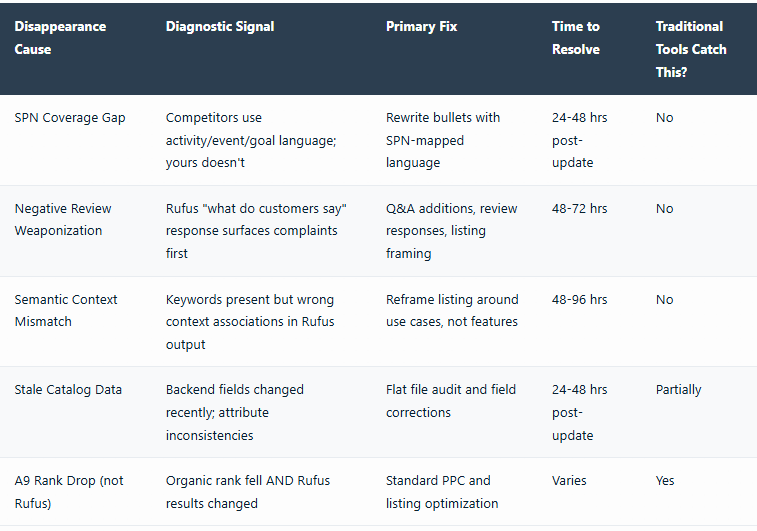
Rufus Disappearance: Cause vs. Fix Matrix
Frequently Asked Questions
How do I know if my ASIN disappeared from Rufus versus just dropping in organic search?
Test both systems independently. Search your primary keyword in regular Amazon search and note your rank. Then ask Rufus a conversational question that should surface your product. If organic rank is stable but Rufus doesn't show you, it's a Rufus-specific issue.
Can fixing Rufus visibility hurt my organic search rank?
Only if you rewrite listings in ways that remove high-performing keywords or significantly alter keyword density. The safest approach is additive: insert SPN language into existing bullets rather than replacing functional keyword content entirely.
How long does it take for listing changes to show up in Rufus results?
Backend catalog data updates typically propagate within 24-48 hours. Listing copy changes can take longer depending on Rufus's re-indexing cycle. Budget 48 hours before retesting after any change.
Do negative reviews permanently damage Rufus visibility?
Not permanently. Rufus's review scoring is dynamic. As new positive reviews accumulate and Q&A content counters problematic narratives, the semantic signal shifts. The process takes time but is not irreversible.
What are the five Subjective Product Needs dimensions I need to cover?
Per Amazon's 2025 WSDM research: subjective properties (quality descriptors), events (occasions the product suits), activities (what users do with it), goals (what outcomes it achieves), and target audiences (who it's designed for).
Does A+ content help Rufus visibility?
A+ content contributes indirectly by providing additional structured product information and use-case context that Rufus can pull from. It's not a primary fix for a disappearance issue but strengthens your overall semantic signal.
If my ASIN disappeared after a listing update, is that the cause?
Almost certainly yes. Recent listing changes that altered keyword balance, product type framing, or bullet structure are a high-probability trigger. Roll back the changes or specifically counteract what shifted to restore Rufus visibility.
Does Rufus treat parent and child ASINs differently in recommendations?
Yes. Each child ASIN is evaluated on its own attributes. Parent ASIN catalog inconsistencies can suppress individual child variants. Auditing variation attribute consistency is a necessary step when a specific variant goes dark.
How many conversational queries should I test to confirm a Rufus disappearance?
Test at least 8-10 distinct query types that include different SPN dimensions: activity-based, event-based, goal-based, and audience-based queries. A disappearance affecting only one query type indicates a targeted SPN gap, not a systemic issue.
Can PPC spend influence Rufus recommendations?
Not directly. Rufus is an organic discovery system and does not incorporate ad spend as a ranking factor. However, PPC-driven sales velocity can influence the underlying catalog data Rufus uses as a trust signal for product relevance.
Key Takeaways
Rufus disappearances are not A9 rank drops. They require a completely separate diagnostic process targeting the AI retrieval layer, not keyword strategy.
The four primary causes are SPN coverage gaps, negative review weaponization, semantic context mismatch, and stale catalog data. Most disappearances involve at least two of these simultaneously.
Amazon's 2025 WSDM research identified five Subjective Product Needs dimensions that Rufus uses to score relevance. Listing copy without explicit SPN language is invisible to this scoring system.
Rufus mines your review corpus dynamically using S-BERT semantic similarity. Negative review patterns for specific use cases can cause the AI to deprioritize your product for those contexts.
Fix backend catalog data first, before touching listing copy. Rufus processes structured fields before it reads titles or bullets.
Use Q&A as a counter-signal to problematic review narratives. Rufus treats authoritative Q&A answers as a distinct data source that can outweigh user-generated review sentiment.
Document your baseline in Rufus before making any changes. Without a before-state, you cannot attribute recovery to specific actions.
References
Dammu, P.P.S., Alonso, O., & Poblete, B. (2025). A shopping agent for addressing subjective product needs.Proceedings of WSDM '25. ACM. https://doi.org/10.1145/3701551.3704124
Amazon Web Services. (2025). How Rufus scales conversational shopping to millions.AWS Machine Learning Blog. https://aws.amazon.com/blogs/machine-learning/how-rufus-scales-conversational-shopping/
Amazon. (2024). Amazon announces Rufus, a new generative AI-powered conversational shopping experience.About Amazon. https://www.aboutamazon.com/news/retail/amazon-rufus
Amazon Science. (2024). The technology behind Amazon's genAI-powered shopping assistant Rufus. https://amazon.science/blog/the-technology-behind-amazons-genai-powered-shopping-assistant-rufus
Harvey, E., Kizilcec, R.F., & Koenecke, A. (2025). Dialect performance disparities in AI shopping assistants.ACM FAccT 2025. https://dl.acm.org/doi/10.1145/3715275.3732137
Disclaimer: Rufus behavior and indexing mechanics are based on observations from managing Amazon accounts and reviewing publicly available Amazon research documentation. Amazon does not publicly disclose all parameters of Rufus's recommendation system. Results from the 48-hour fix protocol vary by category, competitive environment, and listing history.
