
Rufus Optimization for Consumables: The “Frequency + Occasion” Framework
How Amazon Rufus Ranks Consumables Differently: The "Frequency + Occasion" Framework
Quick Answer For consumable products, Amazon Rufus evaluates two signals that traditional A9 ranking never tracked: how well your listing communicates purchase frequency (daily, weekly, monthly), and how clearly it maps to specific usage occasions. Sellers who structure their consumable listings around these signals get picked up in reorder-intent queries and "what should I buy for [event]" conversations that competitors completely miss.
Table of Contents
Why Consumables Are a Different Problem for Rufus
The Frequency Signal: How Rufus Understands Repurchase Intent
The Occasion Signal: How Rufus Maps Products to Moments
Frequency vs. Occasion: What Each Signal Controls
Implementing the Framework in Your Listing
The Reorder Query Problem (And Why Most Listings Fail It)
Frequently Asked Questions
Key Takeaways
References
Why Consumables Are a Different Problem for Rufus
Most Amazon sellers treat consumables like durable goods with a shorter purchase cycle. They optimize titles for category keywords, stuff bullets with ingredient lists, and treat the listing as a single-purchase conversion tool. This mindset made sense under A9. Under Rufus, it leaves serious money on the table.
Rufus doesn't just answer "what should I buy" queries. It now handles conversational reorders: a customer saying "reorder my protein powder from last month" or "what vitamins should I take every morning" is talking to an AI that actively constructs product recommendations from listing context, purchase history, and what Amazon's systems understand about your product's usage pattern.
The distinction matters because Rufus draws on two data layers that traditional search never weighted heavily: the usage cadence implied by your listing and the situational context your product is associated with. For consumables, these two layers — frequency and occasion — are the primary signals that determine whether Rufus surfaces your ASIN in high-intent, ready-to-buy moments or leaves you invisible.
This connects to the deeper issue of how Cosmo's backend data model processes structured product information before Rufus ever examines your title or bullet points. For consumables, the backend fields that communicate usage frequency are read by Cosmo first — meaning a listing that looks polished on the front end but lacks frequency and occasion signals in its structured data starts every Rufus interaction at a deficit.
The Frequency Signal: How Rufus Understands Repurchase Intent
Rufus has agentic capabilities that include what Amazon's engineering team describes as "natural, conversational reordering." Customers can ask Rufus to help them restock products without naming the exact product, and Rufus constructs a recommendation based on purchase history combined with its understanding of how frequently that product category is consumed.
The problem is that Rufus's understanding of "how frequently" a product is consumed comes partly from your listing. If your protein powder listing says nothing about daily use, Rufus has no listing-level signal to prioritize you when a customer asks "what should I reorder for my morning routine?" It relies on purchase history alone, which only helps customers who've already bought from you. New-to-brand discovery in reorder contexts requires explicit frequency language in your listing.
There are three layers of frequency signal that consumable sellers should build into every listing:
1. Temporal language that implies cadence. Phrases like "daily use," "30-day supply," "take each morning," or "refill monthly" communicate rhythm to Rufus in a way that abstract quantity claims don't. "60 capsules" is a count. "60-day supply with one daily dose" is a frequency signal.
2. Quantity-to-duration mapping. Rufus can answer questions like "how long will this last me?" because it can process the relationship between unit count and recommended use. Listing this explicitly in your backend data (item quantity, dosage per serving, servings per container) gives Rufus structured data to work from rather than requiring the AI to infer it from unstructured copy.
3. Routine anchoring language. This is the layer most consumable sellers miss entirely. Tying your product to an established routine — "part of your morning coffee ritual," "add to your nightly skincare routine," "pre-workout staple" — creates an occasion + frequency composite signal. When a customer asks Rufus "what should I have before my workout," your listing's routine anchoring language becomes a relevance match for that conversational query.
Why This Matters for Reorder Attribution: Amazon's downstream attribution model uses a 7-day rolling window to track Rufus-influenced sales. Consumables with strong frequency signals in their listings are more likely to be surfaced in reorder-intent queries, and those sales get attributed to Rufus's recommendation even when the customer doesn't explicitly search. Traditional metrics miss this revenue entirely — which is why most sellers underestimate how much Rufus is already affecting their consumable repeat rate.
The Occasion Signal: How Rufus Maps Products to Moments
Amazon's peer-reviewed research on Subjective Product Needs (SPN), published at WSDM 2025, identifies "Event" as one of the five core dimensions Rufus uses to match products to queries. The Event facet captures both scheduled public events (holidays, seasons) and personal life occasions (birthdays, starting a new diet, post-surgery recovery).
For consumable products, occasion signals are particularly powerful because they convert category-level queries into ASIN-specific recommendations. "What's a good protein powder" is a high-competition category query. "What protein powder is good for someone starting intermittent fasting" is an occasion query — and the seller whose listing explicitly addresses that occasion context wins the recommendation.
The SPN research reveals that Rufus doesn't just pull occasion context from your title and bullets. It also reads occasion signals from customer reviews, Q&As, and the structured backend attributes that Cosmo ingests. This means a consumable product that consistently generates reviews mentioning specific occasions ("I buy this every winter when cold season hits," "perfect for my post-workout recovery") builds an occasion signal profile that your listing copy alone couldn't create.
This has direct implications for how you solicit and shape customer reviews. As we've analyzed in our breakdown of how external citations are replacing listing copy in Rufus recommendations, the text that appears in your review section increasingly matters as much as — or more than — what you write in your product description.
The most actionable occasion signals for consumables fall into four categories:
Seasonal occasions: Cold and flu season, allergy season, summer hydration, holiday entertaining. If your product has seasonal peak demand, your listing should reflect the occasions driving that demand — not just the season itself.
Life stage occasions: Pregnancy vitamins, post-surgery supplements, new parent exhaustion support, perimenopause wellness. These are low-competition occasion signals because most sellers avoid them out of fear of making health claims. The opportunity is in framing them as context without claiming therapeutic outcomes.
Routine transition occasions: Starting a new diet, beginning a fitness program, returning to work after vacation, back-to-school. Consumers in transition states are highly receptive to new consumable purchases, and Rufus's conversational format is especially good at surfacing products that match stated intention ("I'm trying to eat healthier, what should I add to my morning routine?").
Social occasions: Products meant for gifting, household use across multiple family members, or entertaining contexts. These signals broaden the audience Rufus recommends your product to beyond the primary buyer persona.
Frequency vs. Occasion: What Each Signal Controls
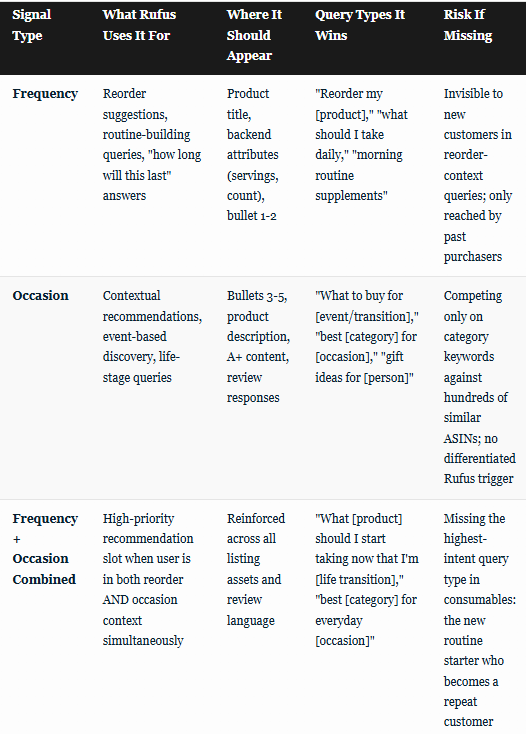
Implementing the Framework in Your Listing
The practical application of frequency and occasion signals looks different depending on which consumable category you're in, but the structural approach is consistent across categories.
Title construction for frequency
Your title should contain at minimum one explicit frequency indicator. This isn't about keyword density — it's about giving Rufus's semantic processing a clear temporal anchor. "Daily Probiotic Supplement" outperforms "Probiotic Supplement" in reorder-context queries not because "daily" is a high-traffic keyword, but because it creates a frequency match with queries that contain "every day," "morning routine," "regular use," and similar variants.
Where product type allows, include the supply duration: "30-Day Supply," "60-Count (2-Month Supply)," or "12-Pack for Monthly Delivery" all create duration signals that Rufus can use when answering stocking and quantity questions in conversation.
Occasion language in bullets and description
Bullets 3 through 5 are where most sellers waste occasion signal potential. Standard feature lists ("contains vitamin C, zinc, elderberry") don't create occasion associations. Occasion-framed bullets do: "Formulated for immune support during high-stress seasons and back-to-school periods when household exposure increases." That single framing creates Rufus associations with seasonal illness, stress, and back-to-school — three distinct occasion contexts in one bullet.
Your product description, being longer and less constrained by bullet format, is where you can weave in multiple occasion scenarios. Think of it less as a features-and-benefits summary and more as a guided tour of when and why someone might reach for your product: morning routines, travel, post-illness recovery, gift consideration. Each scenario you describe becomes a potential occasion match in Rufus's recommendation engine.
Structured backend data
The backend attribute fields that feed Cosmo are where frequency signals have the most structural permanence. As detailed in our analysis of how Cosmo reads structured data before examining listing copy, servings per container, serving size, and usage instructions fields are processed by Cosmo's graph model before Rufus ever touches your title. Completing these fields accurately and with natural language usage instructions (not just regulatory minimums) is the foundational step of frequency optimization.
The Reorder Query Problem (And Why Most Listings Fail It)
Rufus's conversational reordering capability represents a fundamentally new type of commercial intent that Amazon has never monetized before. When a customer asks "help me reorder everything I need for my morning routine," Rufus has to make product-level decisions for items the customer hasn't specifically named. It pulls from purchase history, but it also pulls from its understanding of what products are commonly part of a morning routine and which ASINs have strong routine-frequency signals.
Most consumable listings were built before this query type existed. They were optimized for "find me a protein powder" — a browse-mode query. They weren't written to answer "what are the things I should be reordering regularly for my [use case]" — a completion-mode query. The difference in how Rufus processes these two query types is significant: completion queries weight frequency and routine signals much more heavily than browse queries, which weight category keywords and reviews.
In our work with 7-figure consumable brands at Atomic, we've observed that accounts with strong frequency language in their listings see meaningfully higher inclusion rates in Rufus recommendation responses than accounts whose listings were written for A9 keyword matching. The gap is particularly visible for products in commoditized categories where the physical product is near-identical across ASINs. Rufus uses frequency and occasion signals as a tiebreaker when product attributes are similar — and it's a tiebreaker most sellers don't know exists.
This intersects with the conversion rate risk we've documented in why aggressive Rufus optimization can backfire on conversion rates for sellers who optimize exclusively for AI visibility without considering how their listing reads to a human who lands on the PDP after Rufus recommends it. For consumables, this balance is especially delicate — frequency language that reads naturally in conversational queries can feel impersonal or clinical to a human scanning bullets.
Frequently Asked Questions
Does Rufus treat consumables differently from durable goods when generating recommendations?
Yes. Rufus's conversational reordering capability and routine-based query processing create specific signal weightings for consumables. Purchase frequency context and occasion-based language matter significantly more for repeat-purchase products than for one-time purchases.
What is the "frequency signal" in the context of Amazon Rufus optimization?
The frequency signal is any listing language that communicates how often a product is used: "daily," "30-day supply," "take each morning," or "weekly use." Rufus weights these signals heavily in reorder-intent and routine-building queries from customers.
How do I add occasion signals to a consumable product listing without making health claims?
Frame occasions as context, not claims. "Formulated for use during busy travel seasons" or "popular among new parents managing irregular sleep schedules" establishes occasion context without asserting therapeutic outcomes that could violate Amazon's health claim policies.
Where does Rufus pull occasion signal data from — just the listing, or other sources too?
Rufus pulls occasion signals from listing copy, structured backend attributes, customer reviews, Q&As, and web-grounded sources. For consumables, review language containing occasion context ("I buy this every cold season") contributes to the product's occasion profile in Rufus's model.
What Rufus query types benefit most from frequency optimization in consumables?
Reorder-intent queries ("reorder my supplements"), routine-building queries ("what should I take every morning"), and stocking queries ("how much do I need for a month") all prioritize frequency signals. These query types are growing rapidly as Rufus's agentic features expand.
Should I include frequency language in my product title or just the bullets and description?
Include at least one frequency indicator in your title for maximum Rufus signal strength. "Daily" or "30-Day Supply" in the title creates a persistent frequency anchor that Rufus reads before processing any other listing field.
Does Cosmo's backend processing affect how frequency signals are read for consumables?
Cosmo processes structured fields like servings per container and usage instructions before Rufus examines listing copy. Completing these backend fields accurately is the foundational frequency optimization step that most consumable sellers skip entirely.
Can occasion signals help consumable products compete in categories dominated by established brands?
Yes. Occasion signals differentiate products in commoditized categories where physical attributes are nearly identical. Rufus uses occasion context as a tiebreaker when product specs are similar, giving occasion-optimized listings an advantage over generic category-keyword competitors.
What is a "routine transition occasion" and why does it matter for consumables?
A routine transition occasion is a life moment where someone is establishing new habits — starting a new diet, beginning a fitness program, returning from illness. These buyers are highly receptive to new consumable purchases and generate Rufus queries that occasion-optimized listings can dominate.
How does the 7-day attribution window affect consumable sellers using Rufus?
Amazon's downstream attribution model credits Rufus-influenced sales within a 7-day window, including delayed purchases. Consumables with strong frequency signals appear in more Rufus interactions over time, accumulating attribution data that traditional metrics miss entirely.
Key Takeaways
Amazon Rufus evaluates consumable products on two signals that traditional A9 never tracked: purchase frequency language and occasion context. Listings built for keyword ranking miss both signals entirely.
Frequency signals (daily, 30-day supply, morning routine) directly impact visibility in reorder-intent queries and conversational shopping requests — a query type that's growing as Rufus's agentic capabilities expand.
The five SPN facets from Amazon's WSDM 2025 research include "Event" as a primary dimension. For consumables, this means occasion language in listings, reviews, and Q&As all contribute to Rufus's occasion signal profile for your ASIN.
Cosmo reads structured backend fields (servings per container, usage instructions) before Rufus processes listing copy. Frequency optimization starts with accurate, complete backend data — not just front-end copy rewriting.
Sellers who combine frequency and occasion signals capture the highest-intent consumable buyer: the routine-starter who discovers a product during a life transition and becomes a long-term repeat customer.
The 7-day downstream attribution window means Rufus-influenced consumable sales are systematically undercounted in standard seller metrics. The actual revenue impact of frequency and occasion optimization is larger than most dashboards suggest.
References
Dammu, P.P.S., Alonso, O., & Poblete, B. (2025). "A Shopping Agent for Addressing Subjective Product Needs." WSDM '25: Proceedings of the 18th ACM International Conference on Web Search and Data Mining. https://doi.org/10.1145/3701551.3704124
Amazon Web Services. (2024). "How Rufus scales conversational shopping experiences to millions of Amazon customers with Amazon Bedrock." AWS Machine Learning Blog. AWS ML Blog
Amazon Science. (2023). "The technology behind Amazon's generative AI-powered shopping assistant Rufus." Amazon Science Blog
Amazon Seller Central. Subscribe & Save for Sellers. Seller Central Help
Amazon Web Services. (2024). "Scaling Rufus with over 80,000 AWS Inferentia and Trainium chips." AWS Machine Learning Blog. AWS ML Blog
