The Rufus Attribution Blind Spot: Why Your Amazon AI Revenue Doesn’t Show Up in Reports
The Rufus Attribution Blind Spot: Why Your Amazon AI Revenue Doesn't Show Up in Reports
Quick Answer Amazon's Brand Analytics and advertising reports were built before Rufus existed. When Rufus drives a sale through conversational discovery, that revenue typically appears as unattributed organic — invisible in your AI-driven traffic data and impossible to isolate without indirect measurement workarounds.
Table of Contents
The Attribution Problem Nobody Is Explaining
How Rufus Traffic Flows Through Amazon's Systems
Where Your Reporting Stack Breaks Down
Rufus Attribution vs. Traditional Search Attribution
How to Detect Rufus-Driven Revenue Without Direct Data
The Cosmo Layer: Why the Gap Gets Deeper
What This Means for Budget Allocation and Bidding
Frequently Asked Questions
Key Takeaways
References
The Attribution Problem Nobody Is Explaining
Amazon sellers are increasingly getting traffic from Rufus. They can feel it — their organic sales are bumpy in ways that don't correlate with keyword rank changes or review velocity. But when they open Brand Analytics, Search Term Reports, or their DSP dashboards, there's nothing to explain the variance. The revenue just appears, attributed to "organic," and the conversation is over.
This isn't a reporting glitch. It's a structural gap between when Rufus was deployed (late 2023 into 2024) and when Amazon's attribution infrastructure was designed (years earlier, built around keyword-intent search). Amazon's official Rufus announcement described the assistant as "trained on Amazon's product catalog and information from across the web" — a fundamentally different retrieval architecture than the keyword pipeline that attribution tools were built to track.
As we covered in our analysis of why Rufus optimization can actually hurt conversion rates, the AI surfaces products based on contextual fit and semantic relevance — not the linear search-to-click-to-purchase path that attribution models assume. When the customer journey doesn't follow that linear path, your reporting tools can't reconstruct it.
The result: sellers are making budget and optimization decisions based on incomplete data, not knowing how much of their revenue Rufus is actually driving.
How Rufus Traffic Flows Through Amazon's Systems
To understand why attribution breaks, you need to understand how Rufus surfaces a product in the first place.
When a shopper types "what's a good protein powder for someone who works out at night" into Rufus, the system doesn't run a keyword match against your title. It queries Amazon's Cosmo knowledge graph, which has already pre-computed semantic relationships between product attributes, use cases, and entities. The retrieval happens at the graph level, not the keyword level.
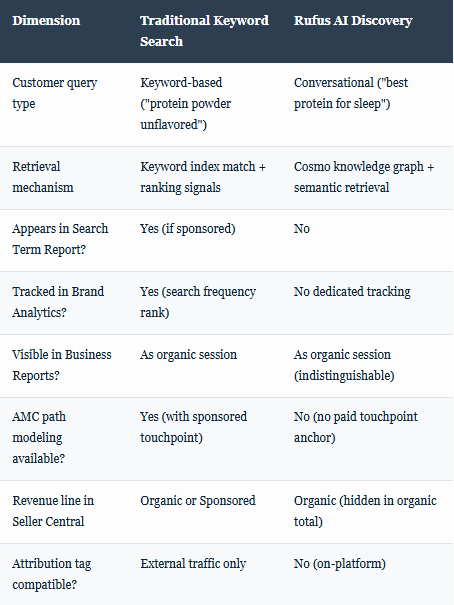
The customer then clicks your product from Rufus's recommendation panel. Here's where attribution fractures. Amazon's systems record the session — the click, the add-to-cart, the purchase — but the entry point data attached to that session doesn't have a "Rufus recommendation" tag that surfaces in seller-facing reports. The session gets logged, the sale gets counted, and it flows into your organic revenue line. But the Rufus touchpoint that initiated the customer journey is not exposed through Brand Analytics, Search Term Reports, or Campaign Manager.
This is confirmed by the absence: Amazon's Brand Analytics documentation lists traffic sources including organic search, sponsored ads, and detail page — but there is no "AI assistant" or "Rufus" channel in any available seller report as of early 2026.
The core issue:Rufus operates on top of a product discovery layer that sits outside Amazon's standard attribution pipeline. A sale that Rufus initiates looks identical to a direct organic sale in every report sellers can access.
Where Your Reporting Stack Breaks Down
Let's map this against specific tools sellers actually use, because the failure mode is different in each one.
Search Term Report
This report is pulled from sponsored ad impressions and clicks. It captures what customers searched before clicking a sponsored result — nothing else. If Rufus surfaced your product and the customer clicked it from the Rufus panel rather than a sponsored position, the Search Term Report has zero visibility into that interaction. The keyword that triggered the Rufus recommendation is not passed to this report.
Brand Analytics — Search Frequency Rank
Brand Analytics tracks search queries and click-share at the keyword level. Again, this is built on the search index, not Rufus's retrieval layer. Conversational queries like "what protein powder should I take before bed" that Rufus processes may never appear as discrete search terms in Brand Analytics, because Rufus transforms them into entity-and-attribute queries internally rather than passing the raw query string to the keyword index.
Business Reports — Detail Page Traffic
Detail page sessions and page views are captured, but source attribution is limited to broad categories. Rufus-driven traffic appears as a session — but the referral source classification doesn't distinguish "Rufus recommendation" from "customer typed in the ASIN directly."
Attribution Tags (External)
Amazon Attribution tags work for off-Amazon traffic sources. They have no application for on-platform Rufus traffic, which originates internally within Amazon's ecosystem.
DSP and AMC
Amazon Marketing Cloud can model multi-touch paths for DSP-driven traffic. But AMC's path analysis only works where there's a paid media touchpoint to anchor the journey. An organic Rufus recommendation generates no paid touchpoint, so AMC can't reconstruct those paths. The Rufus-initiated journeys fall through this gap entirely.
Rufus Attribution vs. Traditional Search Attribution
How to Detect Rufus-Driven Revenue Without Direct Data
Since Amazon doesn't give sellers a Rufus channel report, detecting and estimating Rufus-driven revenue requires indirect methods. None of these are perfect, but used together they create a triangulated picture.
Method 1: Organic Session Variance After Rufus Listing Changes
If you update your product attributes specifically to improve Rufus visibility — structured backend data, use-case language, occasion-based attributes — and your organic sessions increase within a 5-10 day window without any corresponding rank change for your tracked keywords, that delta is likely Rufus-driven. The key is isolating the change: don't run new ad campaigns in the same window.
This connects to the visibility shifts we documented in the Rufus paradox analysis — products gaining organic traffic while their tracked keyword positions stay flat or even decline. That pattern is a Rufus fingerprint.
Method 2: Query Type Analysis in Brand Analytics
Look at the queries driving clicks to your ASIN in Brand Analytics. If you start seeing longer, more conversational or occasion-based search strings appearing (even as low-frequency terms) that you didn't previously rank for, those are likely spillover from Rufus query processing. Rufus sometimes routes queries through the standard search index as a fallback, and those show up in Brand Analytics even when the primary discovery happened in the Rufus panel.
Method 3: Mobile Session Timing Patterns
Rufus usage is disproportionately mobile and concentrated in browse sessions rather than high-intent search sessions. If your mobile organic session share increases — particularly during evening hours when browse behavior peaks — that's a behavioral signal consistent with Rufus-driven discovery rather than intent-based keyword search.
Method 4: Category Share vs. Keyword Rank Divergence
If your category share in Brand Analytics is growing while your exact-match keyword rank holds flat or drops, a secondary discovery mechanism is likely contributing. Rufus is the primary candidate. Traditional search optimization would show correlated keyword rank improvement if it were driving the category share gain.
What the indirect signals tell you: None of these methods give you a number you can put in a report. What they do is confirm whether Rufus is a material traffic driver for your ASINs — and that's enough to inform optimization priority and listing strategy decisions.
The Cosmo Layer: Why the Gap Gets Deeper
Understanding the attribution gap fully requires understanding what Cosmo is and how it sits between Rufus and Amazon's standard systems.
Cosmo is Amazon's entity-relationship knowledge graph that pre-computes connections between products, attributes, use cases, and customer contexts. As we detailed in our breakdown of Cosmo's backend data model and the fields it actually reads, Cosmo operates on structured backend attributes — not front-end copy. When Rufus queries Cosmo, it's retrieving from a pre-built graph, not running a live search against your listing text.
This matters for attribution because Cosmo's graph traversal happens upstream of the customer interaction layer. By the time a customer clicks on your product in a Rufus response, the discovery decision has already been made in Cosmo — and that Cosmo retrieval event doesn't generate a seller-visible log entry. The first event Amazon's seller-facing systems record is the product detail page view, by which point the Rufus/Cosmo origin is stripped from the session data passed to reporting tools.
Amazon's published Cosmo research describes the system as operating on pre-computed knowledge rather than real-time retrieval — which means the attribution gap is an architectural feature, not a bug. The systems were designed to separate discovery logic from transaction logging.
What This Means for Budget Allocation and Bidding
This attribution gap has concrete consequences for how sellers manage their accounts — and most sellers are making systematic errors because of it.
Organic-to-Paid Attribution Is Inflated
If Rufus is driving organic revenue that appears in your "organic" line, your true organic performance looks better than your keyword strategy deserves. This can lead to under-investment in sponsored campaigns, because the organic numbers appear strong. In reality, if Rufus visibility were to decline (due to a listing change, a Cosmo graph update, or a competitor gaining relevance), your organic revenue would drop without any keyword rank signal giving you advance warning.
ACOS and TACOS Calculations Are Distorted
Total ACOS calculations use total sales in the denominator. If Rufus is contributing meaningfully to total sales but those sales are indistinguishable from organic keyword-driven sales, your TACOS looks artificially healthy. You're optimizing your ad spend against a revenue base that includes hidden AI-driven revenue you can't control with bidding adjustments.
Keyword-Level Bidding Decisions Are Made on Incomplete Data
When sellers pause a keyword because it shows poor conversion, they're assuming that keyword's ad traffic is the only thing bringing customers in on that intent. If Rufus is also driving traffic for related conversational queries — which it likely is for any reasonably well-structured listing — pausing the sponsored keyword removes a visibility layer while Rufus continues operating silently. The keyword may actually be profitable when Rufus's contribution to that intent cluster is accounted for.
This is why the sudden visibility drops that sellers experience after ASIN changes are so disorienting — they often don't show up as keyword rank losses, because it wasn't keyword rank driving the traffic in the first place.
In our work with 7-figure sellers at Atomic, we've started treating Rufus-driven revenue as a separate mental model from keyword-driven revenue — even without being able to measure it directly. The behavioral signals (organic session variance, category share divergence, mobile session patterns) get tracked separately from keyword rank data, and optimization decisions account for both layers.
Frequently Asked Questions
Does Amazon show Rufus traffic in any seller report?
No. As of early 2026, Amazon has not added a Rufus-specific traffic source to Brand Analytics, Business Reports, or Campaign Manager. Revenue from Rufus discovery appears as unattributed organic.
Why does Rufus revenue show up as organic instead of a separate channel?
Amazon's reporting infrastructure predates Rufus. The attribution pipeline records the first seller-visible event — the product detail page view — by which point the Rufus/Cosmo origin data has been stripped from the session record passed to seller-facing reports.
Can Amazon Marketing Cloud (AMC) track Rufus-driven sales paths?
No. AMC path modeling requires a paid media touchpoint to anchor the journey. Organic Rufus recommendations create no paid touchpoint, so AMC cannot reconstruct those paths or attribute them separately from other organic sessions.
How can I estimate how much revenue Rufus is driving without direct data?
Use indirect signals: track organic session variance after Rufus-focused listing updates, monitor category share vs. keyword rank divergence, and watch for mobile session timing patterns consistent with browse behavior rather than intent-based search.
Does the Rufus attribution gap affect TACOS calculations?
Yes. If Rufus contributes to total sales but those sales are indistinguishable from organic keyword-driven revenue, TACOS calculations include hidden AI-driven revenue in the denominator, making ad efficiency appear healthier than keyword performance alone justifies.
Should I pause keywords if my organic sales look strong despite Rufus attribution gaps?
Be cautious. Strong organic numbers may partly reflect Rufus-driven revenue that isn't sensitive to keyword bids. Pausing keywords removes a sponsored visibility layer while Rufus continues operating independently — the two channels are not interchangeable.
What role does Cosmo play in the attribution gap?
Cosmo's graph traversal happens upstream of the customer interaction layer. The discovery decision is made in Cosmo before any seller-visible session event is generated, so the Cosmo/Rufus origin is never attached to the transaction record sellers can access.
Will Amazon ever add a Rufus channel to seller reporting?
Amazon has not announced plans to expose Rufus attribution in seller-facing tools. Given that Cosmo operates pre-session, architectural changes to how discovery events are logged would be required — a significant infrastructure undertaking with no confirmed roadmap.
Does Rufus attribution affect how I should structure my listing content?
Yes. Since Rufus discovery can't be tracked like sponsored traffic, optimizing your listing for Rufus via backend attributes and use-case data is a faith-based investment — validated through indirect signals rather than direct attribution metrics.
Can external traffic attribution tags help track Rufus-driven revenue?
No. Amazon Attribution tags are designed for off-Amazon traffic sources. Rufus is an on-platform discovery mechanism with no external entry point, so Attribution tags have no application for Rufus traffic measurement.
Key Takeaways
Amazon's reporting tools — Brand Analytics, Search Term Reports, Business Reports, AMC — were built before Rufus existed and have no mechanism to surface Rufus as a distinct traffic channel.
Revenue generated through Rufus discovery flows into the organic sales line and is indistinguishable from keyword-driven organic sessions in every seller-facing report.
Cosmo's pre-session architecture is a primary reason for the gap: by the time a seller-visible event is recorded, the Rufus/Cosmo origin has already been separated from the session log.
TACOS calculations are distorted by Rufus's invisible revenue contribution — sellers may be managing ad spend against a false baseline that includes unmeasured AI-driven sales.
Indirect detection methods (organic session variance after listing changes, category share vs. keyword rank divergence, mobile session patterns) provide behavioral signals that can validate whether Rufus is a material driver — even without direct data.
Keyword-level bidding decisions made without accounting for Rufus's parallel contribution to intent clusters risk removing ad coverage that complements invisible Rufus traffic on the same queries.
There is no current Amazon roadmap to expose Rufus attribution in seller tools. Planning for continued measurement opacity is more realistic than waiting for a reporting fix.
References
Amazon. "Introducing Rufus, Amazon's expert AI shopping assistant." About Amazon, September 2023. aboutamazon.com
Amazon Science. "How Amazon Rufus was built to handle the complexity of a product catalog that is growing daily." amazon.science
Amazon Seller Central. "Brand Analytics Overview." sellercentral.amazon.com
Amazon Science. "Cosmo: A Large-Scale E-Commerce Common Sense Knowledge Generation and Serving System at Amazon." amazon.science
Amazon Seller Central. "Amazon Attribution." sellercentral.amazon.com
This analysis is based on publicly available Amazon documentation, official Amazon Science publications, and observed patterns across seller accounts. Attribution behavior may change as Amazon updates its platform. All observations reflect the state of Amazon's reporting tools as of early 2026.
Find out if your Brand is invisible to Amazons Rufus AI discovery tool and how to close the Gaps.
