
The 3 Rufus Signals That Matter More Than Your Title (And Why Most Listings Are Optimizing the Wrong Fields)
Wednesday, February 25, 2026
The 3 Rufus Signals That Matter More Than Your Title (And Why Most Listings Are Optimizing the Wrong Fields)
By Atomic AMZ | February 2026 | Amazon AI Optimization
Quick Answer Rufus weighs structured product type attributes, SPN-aligned review signals, and catalog aspect completeness far more than title keyword density. Sellers obsessing over title rewrites are optimizing last year's algorithm.
Table of Contents
Why Title Obsession Is Misleading Sellers
Signal 1: Structured Product Type Attributes
Signal 2: SPN-Aligned Review Signals
Signal 3: Catalog Aspect Completeness
Signal Comparison Table
The Practical Audit Process
FAQs
Key Takeaways
Why Title Obsession Is Misleading Sellers
Ask most Amazon optimization consultants what to do first for Rufus, and you'll get the same answer: rewrite the title. Front-load your keywords. Add use-case phrases. Pack in occasion signals. It's a rational instinct if you assume Rufus works like A9 — a keyword-matching system where the title gets the heaviest relevance weight.
Rufus doesn't work like A9.
According to Amazon's research published at WSDM 2025 (the ACM Conference on Web Search and Data Mining), Rufus uses a neuro-symbolic architecture that separates catalog-structured information from unstructured copy. The system processes product aspect data, customer review semantics, and what Amazon researchers call "Subjective Product Need" (SPN) signals as distinct input channels. Title text is one input among many — and in conversational query contexts, it's not even the highest-weight one.
What actually moves the needle for most ASINs falls into three signal categories that most sellers haven't touched. As we've documented in our breakdown of Cosmo's backend data model, the structured fields sitting behind your listing front-end carry more indexing weight in AI-driven discovery than anything visible to the customer.
1Signal 1: Structured Product Type Attributes
Amazon's catalog is organized around product types, each with a specific attribute schema. When you list a "yoga mat," Amazon doesn't just store that string — it maps it to a product type node with associated facets: material, thickness, surface texture, length, non-slip rating, intended use level. These facets are the language Rufus speaks natively.
The reason this matters more than your title: when Rufus handles a conversational query like "I need a yoga mat for hot yoga that won't slip even when I sweat," it doesn't parse your title text and look for "hot yoga" in the string. It traverses structured aspect data. As Amazon's official technical documentation on Rufus's architecture makes clear, the AI uses product catalog data as its primary structured knowledge source — catalog attributes get processed by the symbolic reasoning layer before the LLM ever generates a response.
That has a practical implication most sellers miss: a listing with a mediocre title but complete product type attribute data will outperform one with a perfectly optimized title and incomplete backend attributes when Rufus handles faceted queries.
What to check: Navigate to your ASIN in Seller Central and look at the "Product Details" tab in your catalog contribution. Are all category-specific attributes populated? Surface material, compatibility specs, weight ratings, intended user demographics — every blank attribute is a missed retrieval signal for Rufus's structured data layer.
The issue is compounding. Most third-party tools built for A9 optimization don't surface these fields at all. They analyze titles, bullets, and search term fields. The attribute schema lives in a different part of Seller Central that most sellers visit once at listing creation and never return to. That gap is exactly where Atomic's approach differs — systematic attribute audits surface more Rufus visibility improvements than any copy rewrite we've tested.
2Signal 2: SPN-Aligned Review Signals
The WSDM 2025 Amazon paper introduces a formal framework called Subjective Product Needs (SPN) — five categories of user requirements that don't map to catalog attributes: subjective properties ("sturdy," "lightweight"), event relevance ("Christmas gift," "graduation present"), activity suitability ("hiking," "home office"), goal/purpose ("help me sleep better"), and target audience ("toddler," "beginner runner").
Here's the counterintuitive part: Rufus uses customer reviews as its primary source for SPN signals, not your listing copy. The research paper describes a review ranking algorithm that computes semantic similarity between user SPN descriptions and review text, then surfaces reviews with the highest relevance score to ground its recommendations. What buyers write in reviews is literally feeding Rufus's understanding of your product's subjective fit.
That means a listing with 200 generic "great product, fast shipping" reviews is SPN-invisible to Rufus, regardless of how well-written your bullets are. A competing ASIN with 80 reviews where buyers describe using it during their camping trips, mentioning it held up in rain, felt lightweight for long hikes — that ASIN accumulates SPN signal that shows up when customers ask Rufus "what's a good bag for wet weather hiking."
The blind spot: You cannot audit your SPN review signal with standard review analysis tools. Those tools track sentiment and keyword frequency. SPN signal is about semantic match to use-case categories — something you have to assess manually or with purpose-built semantic search.
The practical implication: your post-purchase follow-up communication should be engineered to elicit SPN-rich reviews, not just star ratings. Buyers should be prompted to describe when and how they use the product, not just whether they liked it. Review response strategy also matters here — seller responses that add context, clarify use cases, or expand on product scenarios are processed by Rufus as additional SPN data. This connects directly to what we covered in our analysis of how external citations are replacing listing copy in Rufus's retrieval pipeline.
3Signal 3: Catalog Aspect Completeness Score
This one has no official name in Amazon's documentation, but the behavior is well-documented in practice. Amazon has been pushing sellers to complete more catalog attributes for years — A+ Content requirements, expanded bullet point allowances, AI listing suggestions that add attribute data. That push is not cosmetic. It reflects how Rufus scores listings for retrieval confidence.
Rufus operates as a recommendation engine that needs to confidently match products to queries. When critical aspects for a product type are missing, Rufus's ability to answer "will this work for my use case?" is degraded. The system can't confidently recommend a product it doesn't have complete attribute data for when the query is attribute-specific.
According to Amazon Seller Central's listing quality guidance, product attribute completeness directly affects search and discovery performance — and that guidance predates Rufus, meaning the pattern extends into AI systems that depend on the same catalog infrastructure.
The aspect completeness signal is most obvious in product types with deep attribute schemas: electronics, home appliances, health supplements, sporting goods. These categories have 30–60 required and optional attributes in their product type definitions. Most listings in these categories are 40–60% complete. The listings at 85–95% completeness are the ones appearing in Rufus recommendations for complex, multi-attribute queries.
A useful diagnostic: search your product type category in Amazon's Browse Node structure and identify what Rufus consistently surfaces when you ask conversational questions about your category. The products it defaults to almost always have deeper attribute data than the ones it ignores — including some ASINs with worse conversion rates and review counts. Aspect completeness is functioning as a baseline qualifier for Rufus inclusion, not just a ranking factor.
This dynamic is worth understanding alongside the broader suppression patterns we've tracked — as documented in our research on the 12 product attributes that flag ASINs in Rufus, incomplete or conflicting attribute data creates visibility penalties that no amount of copy optimization can overcome.
Signal Comparison: Where Most Sellers Are vs. Where Rufus Looks
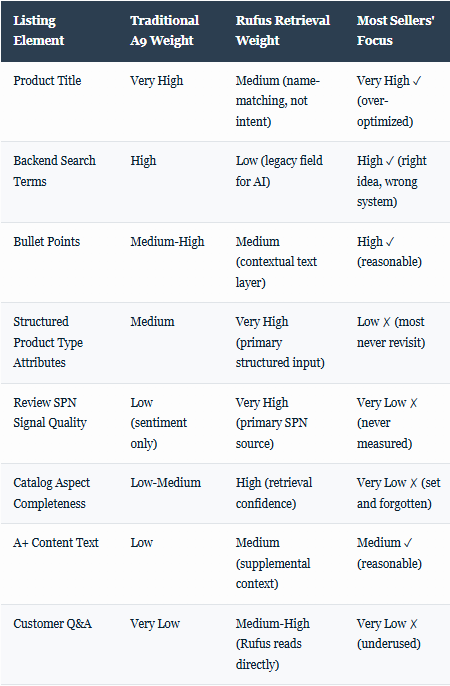
The gap between column 3 and column 4 is where most 7-figure sellers are leaving Rufus visibility on the table. The optimization work they've done is correct for A9 — it just isn't addressing how Rufus actually retrieves and ranks products.
The Practical Audit Process
If you want to assess your own signal health before doing any rewriting, start with these three checks:
First, run a catalog attribute audit. Download your ASIN's product data via the inventory file template for your category (available in Seller Central's "Add Products via Upload" section). Open the template, filter to your product type, and compare the attribute columns to what's populated in your listing. Count how many optional and required attributes are blank. Anything under 75% completion is a Rufus retrieval gap.
Second, evaluate your SPN review coverage. Pull your 50 most recent reviews and categorize each by whether it contains: a specific use case, an occasion/event reference, a subjective property ("sturdy," "comfortable"), a target audience mention, or a goal/outcome statement. The percentage of reviews with at least one SPN signal is your baseline. Industry observation suggests most listings average 20–35% SPN-rich reviews. Competitors appearing regularly in Rufus tend to run 50%+.
Third, test Rufus directly with intent-based queries. Open a fresh browser session (or use a secondary account) and ask Rufus conversational questions that describe your customer's actual purchase context. Note whether your ASIN appears. Then look at what does appear — and examine those listings' structured attribute data. The pattern reveals exactly which signals are driving Rufus's choices in your category.
This three-step process is the foundation of what we document at the start of every optimization engagement — a Rufus signal audit before any copy changes, to ensure rewrites address actual gaps rather than surface-level assumptions. For categories where the Rufus paradox is most acute, this sequencing is the difference between improvements that compound and changes that accidentally depress A9 performance while chasing Rufus visibility.
One more thing worth flagging:Sellers in categories with high Rufus query volume (home, health, sporting goods, electronics) should know that optimizing purely for Rufus can hurt conversion rate if the changes aren't calibrated for dual A9/Rufus performance. The three signals above are additive — they build Rufus visibility without requiring copy changes that damage traditional search performance.
Frequently Asked Questions
Does Amazon's Rufus read the product title to make recommendations?
Yes, but title text is one of the lower-weight inputs for intent-based queries. Rufus prioritizes structured catalog attributes and review semantics over title keyword matching when handling conversational queries about use cases or occasions.
What are Subjective Product Needs (SPN) signals in the context of Rufus?
SPNs are five query categories Amazon researchers identified: subjective properties, events, activities, goals/purposes, and target audiences. Rufus uses SPN classifiers to understand query intent and matches those to SPN-rich review content on product listings.
How do I find which product type attributes are missing from my listing?
Download the inventory file template for your category in Seller Central under "Add Products via Upload." Filter to your product type and compare all attribute columns against your existing listing data. Blank fields are retrieval gaps for Rufus.
Can customer reviews really affect Rufus visibility?
Yes, significantly. Amazon's WSDM 2025 research paper describes a review ranking algorithm that computes semantic similarity between user queries and review text. Reviews with specific use cases, occasions, and subjective attributes score higher and feed Rufus recommendations.
Is backend search term optimization still worth doing for Rufus?
Backend search terms remain important for A9 ranking but carry much lower weight for Rufus retrieval. Sellers should maintain keyword-optimized search terms for A9 while investing separately in structured attribute completeness and review SPN quality for Rufus.
What percentage of catalog attributes should I aim to complete for Rufus visibility?
Listings appearing consistently in Rufus recommendations for complex queries typically have 80–95% attribute completion rates. Most categories see significant retrieval improvements moving from 50% to 75% completion, with diminishing returns above 90%.
Does Rufus use A+ Content for product recommendations?
Yes, Rufus processes A+ Content text as supplemental context. It's a medium-weight signal, particularly useful for subjective properties and use-case descriptions that don't fit neatly into structured attribute fields or bullet points.
How does the customer Q&A section factor into Rufus visibility?
Rufus reads Q&A content directly as a knowledge source when generating responses to customer questions. An active, detailed Q&A section covering common use-case and compatibility questions materially improves how Rufus answers queries about your product.
Will optimizing these three signals hurt my existing A9 keyword rankings?
No — structured attribute completion, review quality improvement, and aspect completeness are additive signals. They build Rufus visibility without requiring title or bullet changes that might affect A9 ranking. They're the safest place to start Rufus optimization.
How do I tell if my product is currently invisible to Rufus?
Use a fresh browser session and ask Rufus several conversational queries that describe your customer's use case. If your ASIN doesn't appear across 5+ relevant queries, you have a Rufus signal gap. Cross-reference with what does appear to identify the competing signals.
Key Takeaways
Rufus uses structured catalog attribute data as its primary retrieval layer — not title keywords. Listings with complete product type attributes consistently outperform better-titled competitors in conversational query results.
Customer reviews are Rufus's main source for Subjective Product Need (SPN) signals. Review quality — not just volume or rating — determines whether Rufus can confidently recommend your product for occasion, activity, and use-case queries.
Catalog aspect completeness functions as a retrieval confidence qualifier. When Rufus can't answer "will this work for X" from structured data, it deprioritizes the listing — regardless of ranking or sales history.
The three signals identified here (structured attributes, review SPNs, aspect completeness) are additive to A9 optimization. Improving them does not require title or bullet changes that could hurt existing keyword rankings.
Most professional optimization tools audit A9-relevant fields only. The Rufus signal gaps are in fields those tools don't surface, which is why the problem is widespread even among sophisticated sellers.
A practical audit — attribute completeness check, SPN review analysis, live Rufus query testing — takes 2–3 hours per ASIN and surfaces more actionable intelligence than any copy review.
References
Dammu, P.P.S., Alonso, O., & Poblete, B. (2025). "A Shopping Agent for Addressing Subjective Product Needs."WSDM 2025 Proceedings. DOI: https://doi.org/10.1145/3701551.3704124
Amazon Science. (2023). "The technology behind Amazon's GenAI-powered shopping assistant Rufus." Amazon.science. https://www.amazon.science/latest-news/the-technology-behind-amazons-gen-ai-powered-shopping-assistant-rufus
Amazon Seller Central. (2024). "Improve your listings with listing quality recommendations." https://sellercentral.amazon.com/help/hub/reference/external/help?itemID=201836080
Amazon Seller Central. (2024). "Add one product at a time." Product type attribute schema documentation. https://sellercentral.amazon.com/help/hub/reference/200220550
Hu, Y., et al. (2024). "Rufus: Conversational Product Search at Amazon." Amazon AWS Machine Learning Blog. https://aws.amazon.com/blogs/machine-learning/
Technical claims in this post are grounded in Amazon's published research and platform documentation. Seller Central interface paths and attribute schema specifics may change with platform updates. Validate current attribute availability in your specific product type before applying.
Find out if your Brand is invisible to Amazons Rufus AI discovery tool and how to close the Gaps
