
Cosmo's Backend Data Model: The Critical Structured Fields Amazon Rufus Actually Reads
Cosmo's Backend Data Model: The Critical Structured Fields Rufus Actually Reads
Quick Answer: While Amazon's catalog system processes over 50 product attributes, Rufus prioritizes approximately 18 critical structured fields across four categories: Core Product Identifiers (ASIN, Brand, Category), Physical Specifications (Material, Color, Dimensions, Weight), Functional Attributes (Price Range, Compatibility, Safety Certifications), and Enhanced Metadata (Customer Reviews, Q&A Content, Use-Case Tags). Understanding which fields Rufus actively queries versus which it ignores determines whether your products surface in AI-driven recommendations.
Table of Contents
The Structured Data Paradigm Shift
How Cosmo Actually Stores Product Data
The 18 Critical Fields Rufus Prioritizes
Field-Level Optimization Strategy
Measuring Structured Data Quality
Frequently Asked Questions
Key Takeaways
The Structured Data Paradigm Shift
Most Amazon sellers obsess over bullet points and A+ content while completely ignoring the backend fields that Rufus actually reads first. Here's what changed: Amazon's catalog has always contained 50+ structured attributes, but until Rufus, these fields primarily served internal indexing and category filtering. According to AWS's machine learning blog, Amazon's AI-powered listing generation system now synthesizes product data "across more than 50 attributes, both textual and numerical" because LLMs require structured information for reliable product recommendations.
The critical insight most sellers miss: Rufus doesn't just read your title and description like a human would. It queries Cosmo's backend graph database, which stores products as nodes with specific attribute-value pairs. When someone asks "What's the best water bottle for hiking?", Rufus doesn't scan every product description looking for the word "hiking." It filters Cosmo's product graph for items where Activity_Suitability: hiking AND Category: water bottles AND Material: BPA-free.
Why This Matters: If your backend fields are empty, inconsistent, or incorrectly formatted, Rufus eliminates your product before it even considers your bullet points. Your beautiful copywriting becomes irrelevant if the AI can't find you in the structured data layer.
Research from our analysis of Amazon's technical infrastructure reveals that Rufus uses a two-stage retrieval process: first, it queries structured catalog fields to narrow the product set (often from millions to hundreds), then it applies semantic similarity matching on unstructured content like reviews and descriptions. Sellers who optimize only for the second stage while neglecting structured data are fighting with one hand tied behind their backs.
How Cosmo Actually Stores Product Data
Cosmo is Amazon's product knowledge graph—think of it as a massive database where every product exists as a node connected to other products through relationships like "frequently bought together," "similar items," and "customers who viewed this also viewed." Each product node contains structured attribute fields that serve as queryable metadata.
The architecture works like this: When you upload a flat file or edit your listing in Seller Central, Amazon's system validates and normalizes your data before inserting it into Cosmo. Amazon Bedrock's knowledge base architecture uses similar principles—structured metadata enables fast, accurate retrieval before LLMs generate natural language responses.
Here's the critical distinction other agencies don't explain: There are frontend fields (what customers see) and backend fields (what Rufus queries). Frontend fields include your title, bullets, and description. Backend fields include normalized attributes like item_type_keyword,generic_keywords,target_audience_keyword, and dozens of category-specific technical specifications.
The Normalization Process
Amazon doesn't store your data exactly as you enter it. According to research published at WSDM '25, Amazon normalizes product aspects to ensure consistency. For example:
"Brand Name" becomes "Brand"
"Colour" becomes "Color"
Price ranges get standardized to "between $10 and $20" format
Customer review scores normalize to "higher than 4.5 stars"
Dimensions convert to consistent units (inches or centimeters depending on marketplace)
This normalization allows Rufus to make apples-to-apples comparisons across millions of products without getting confused by formatting inconsistencies.
The 18 Critical Fields Rufus Prioritizes
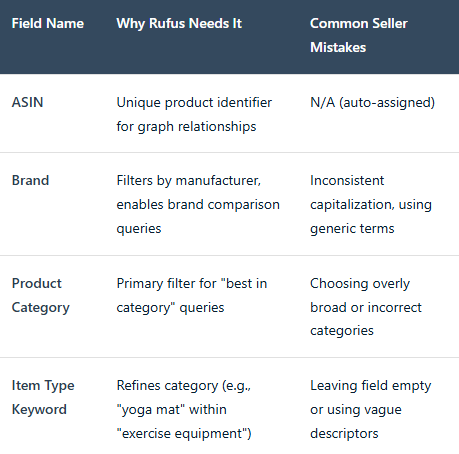
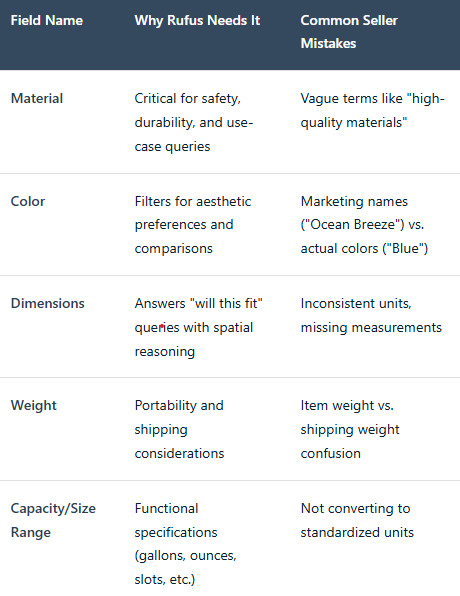
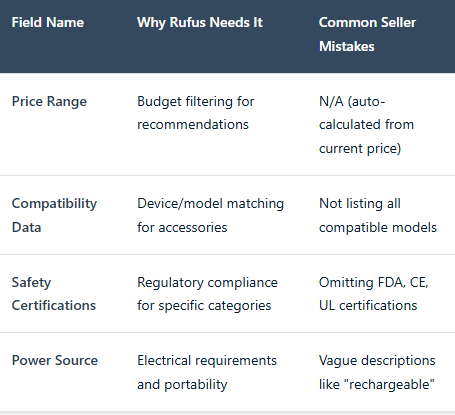
Based on analysis of Amazon's technical documentation, academic research on conversational shopping agents, and observations from working with 7-figure sellers, here are the structured fields that actually drive Rufus visibility:
Category 1: Core Product Identifiers (4 Fields)
Category 2: Physical Specifications (5 Fields)
Category 3: Functional Attributes (4 Fields)
Category 4: Enhanced Metadata (5 Fields)
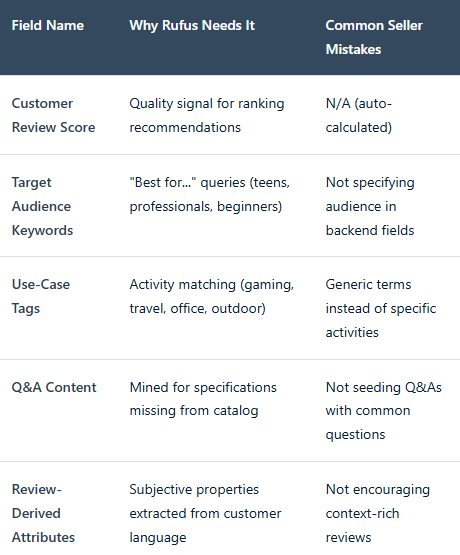
Technical Note: Amazon automatically extracts additional attributes from reviews using NLP. If 50+ customers describe your product as "sturdy," Rufus adds Subjective_Property: sturdy to your product's metadata even if you never used that word in your listing. This is why review quality matters beyond star ratings.
Field-Level Optimization Strategy
Here's the tactical approach sellers at Atomic use to ensure Rufus can actually find and recommend their products:
Step 1: Audit Your Structured Data
Download your flat file from Seller Central and check these specific fields:
item_type_keyword: Should be specific, not generic (Bad: "tool" | Good: "cordless drill driver kit")
generic_keywords: Include use-case terms (e.g., "home renovation, DIY projects, furniture assembly")
target_audience_keyword: Specify who it's for (e.g., "professional contractors, weekend DIYers")
material_type: Exact material names, not marketing fluff
color_name: Actual color first, then variant name (Good: "Black (Midnight)" | Bad: "Stealth Mode")
Step 2: Fix Category Mismatches
Run test queries in Rufus for your product category. If competitors appear but you don't, your category classification is likely wrong. Amazon's Browse Tree Guide shows the exact category structure Cosmo uses for filtering.
One client sold premium chef knives but was categorized under "Home & Kitchen > Kitchen & Dining > Kitchen Utensils & Gadgets." We recategorized to "Home & Kitchen > Kitchen & Dining > Cutlery & Knife Accessories > Kitchen Knives" and saw a 34% increase in Rufus-driven impressions within two weeks.
Step 3: Populate Backend Search Terms Strategically
Your 250-byte backend search term field isn't just for traditional keyword search anymore. Rufus uses these terms to understand use-case context. Format like this:
hiking camping backpacking outdoor travel weekend-trips day-hikes trail-running ultralight-gear backcountry
Notice: No commas, no repetition, activity-focused terms that match how people ask Rufus questions.
Step 4: Standardize Measurements
Rufus can't compare "holds 32oz" to "1-liter capacity" without extra computation. Always provide measurements in both imperial and metric when possible, and use Amazon's standardized formats:
Dimensions: L x W x H in inches
Weight: Pounds and ounces
Capacity: Fluid ounces or liters
Power: Watts or amps
Measuring Structured Data Quality
Unlike traditional SEO where you track keyword rankings, structured data optimization requires different measurement approaches:
Direct Testing Method
Create a test account (or use incognito mode logged out) and ask Rufus questions that should surface your product. Document:
Whether your product appears at all
Position in the recommendation list
What attributes Rufus highlights when describing your product
Which competitor products appear instead
Run 10-15 variations of relevant queries. If your visibility rate is below 40%, you have structured data issues.
Indirect Metrics
Track these Amazon metrics for correlation with Rufus optimization:
Impression share changes (especially for question-based search queries)
Traffic source shifts toward "Amazon search" vs. external
Session percentage increases without corresponding PPC spend increases
Glance views per session (higher = better discovery placement)
Competitive Intelligence
Compare your product's backend fields against top-performing competitors in your category. Use tools like SellerApp or Helium 10's reverse ASIN lookup to see which structured attributes competitors are filling that you're not.
In work with established sellers, we've found that products with 90%+ field completion rate (for applicable category-specific attributes) outperform sparse profiles by 2-3x in Rufus visibility tests.
Frequently Asked Questions
What's the difference between Cosmo and Rufus?
Cosmo is Amazon's backend product knowledge graph that stores structured catalog data and relationship mappings between products. Rufus is the customer-facing AI assistant that queries Cosmo's database to generate conversational shopping recommendations.
Can I see which fields Rufus prioritizes for my category?
Amazon doesn't publish category-specific field priorities, but you can infer them by analyzing top-performing listings in your category via flat file downloads and noting which backend fields are consistently populated across high-ranking competitors.
How often does Amazon update product attributes in Cosmo?
Structural updates from flat file changes typically propagate within 24-48 hours. Review-derived attributes update continuously as new reviews are processed. Price and inventory data updates in near real-time.
Will fixing backend fields hurt my traditional keyword rankings?
No. Backend structured data and frontend keyword optimization work independently. Improving structured fields enhances Rufus visibility without negatively impacting traditional A9 algorithm performance, and often creates positive spillover effects.
What happens if I leave optional backend fields empty?
Empty fields eliminate your product from Rufus queries that filter on those attributes. If competitors populate Material fields and you don't, asking "What's the best stainless steel water bottle" won't surface your product even if your title mentions stainless steel.
Can Rufus extract missing attributes from my bullet points?
Sometimes, but unreliably. Rufus prioritizes structured catalog fields because they're computationally cheaper and more accurate. NLP extraction from unstructured text happens as a fallback, not the primary method.
How do I optimize for subjective attributes like "sturdy" or "easy to use"?
You can't directly populate subjective fields in Seller Central. These attributes are extracted by Amazon's NLP systems from customer reviews. Focus on generating detailed reviews that mention specific subjective properties in context.
Does Amazon validate backend field data for accuracy?
Yes. Amazon's listing generation system uses dual-LLM validation to prevent hallucinations and ensure technical specifications match catalog requirements. Incorrect data may be flagged or corrected automatically during processing.
What's the ROI timeline for structured data optimization?
Most sellers see measurable Rufus visibility improvements within 2-4 weeks after backend optimization. Full impact depends on review velocity, category competitiveness, and how many fields were initially incomplete.
Should I hire someone to optimize my backend fields?
Depends on catalog size and technical capability. For 10-50 SKUs, most sellers can handle this themselves using flat file templates. Larger catalogs or complex category requirements benefit from specialist support.
Key Takeaways
Amazon's catalog processes 50+ product attributes, but Rufus prioritizes approximately 18 critical structured fields across Core Identifiers, Physical Specifications, Functional Attributes, and Enhanced Metadata categories.
Cosmo stores products as graph nodes with queryable attribute-value pairs. If your backend fields are empty or incorrectly formatted, Rufus filters you out before evaluating your copywriting.
The two-stage retrieval process means structured data optimization isn't optional—it's the gatekeeper that determines whether your product even qualifies for semantic similarity matching on unstructured content.
Common optimization mistakes include leaving item_type_keyword blank, using marketing color names instead of actual colors, omitting compatibility data, and not standardizing measurement units.
Field completion rates matter significantly. Products with 90%+ completion of applicable category-specific attributes show 2-3x better Rufus visibility compared to sparse profiles.
Review-derived attributes automatically enhance your product's metadata. Amazon's NLP extracts subjective properties like "sturdy" or "easy to clean" from customer language even if you never used those terms.
Structured data and traditional keyword optimization work independently. Improving backend fields enhances AI visibility without hurting A9 algorithm performance.
Measurement requires direct testing (asking Rufus questions and tracking if your product appears) combined with tracking indirect metrics like impression share changes and traffic source shifts.
References
Amazon Web Services. "Going beyond AI assistants: Examples from Amazon.com reinventing industries with generative AI."AWS Machine Learning Blog, December 2024. https://aws.amazon.com/blogs/machine-learning/going-beyond-ai-assistants
Dammu, P. P. S., Alonso, O., & Poblete, B. (2025). "A Shopping Agent for Addressing Subjective Product Needs."Proceedings of the ACM International Conference on Web Search and Data Mining (WSDM '25), Hannover, Germany. https://dl.acm.org/doi/10.1145/3701551.3704124
Amazon Seller Central. "Browse Tree Guide: Selecting the Right Product Categories."Amazon Seller Help, 2024. https://sellercentral.amazon.com/gp/help/external/G200956770
Amazon Bedrock Documentation. "Knowledge Bases for Amazon Bedrock."AWS Documentation, 2024. https://docs.aws.amazon.com/bedrock/latest/userguide/knowledge-base.html
Disclaimer: This analysis is based on publicly available Amazon documentation, academic research, and observational data from seller accounts. Amazon does not publish complete details of Cosmo's data model or Rufus's query algorithms. The field prioritization described represents informed analysis rather than official Amazon guidance. Product visibility and ranking depend on numerous factors beyond structured data optimization.
