
Inside Amazon's $10B Attribution Model: How Amazon Rufus Revenue Is Actually Tracked
Inside Amazon's $10B Attribution Model: How Rufus Revenue Is Actually Tracked
Quick Answer: Amazon tracks Rufus revenue through a 7-day rolling "downstream impact" attribution model that captures delayed conversions. This methodology has helped Rufus generate $10B+ in annualized incremental sales, with customers 60% more likely to purchase when using the AI assistant.
Table of Contents
The $10 Billion Question: How Amazon Measures Rufus Success
What "Downstream Impact" Actually Means
Inside the 7-Day Rolling Attribution Window
The Key Metrics Amazon Actually Tracks
Traditional vs. Rufus Attribution Models
What This Means for Amazon Sellers
Frequently Asked Questions
Key Takeaways
The $10 Billion Question: How Amazon Measures Rufus Success
When Amazon CEO Andy Jassy disclosed during the Q3 2025 earnings call that Amazon Rufus was on track to generate $10 billion in annualized incremental sales, sellers and industry analysts immediately wanted to know: how is Amazon actually calculating that number?
The answer reveals a sophisticated attribution methodology that goes far beyond traditional click-to-conversion tracking. Amazon uses what it internally calls "downstream impact" (DSI), a metric specifically designed to capture the full economic value of AI-assisted shopping interactions, even when purchases don't occur immediately after a Rufus conversation.
This isn't theoretical. By Q4 2025, that $10 billion projection had grown to $12 billion in actual incremental revenue, with over 300 million customers using Rufus throughout the year. The attribution model powering these calculations represents Amazon's most advanced approach to measuring AI-driven commerce.
What "Downstream Impact" Actually Means
Unlike traditional attribution models that credit the last click before purchase, Amazon's downstream impact methodology tracks the ripple effects of Rufus interactions across multiple sessions and days. When a customer asks Rufus "What's the best wireless headphones for running?" but doesn't purchase immediately, Amazon's system continues monitoring that customer's behavior.
The downstream impact metric captures three distinct revenue categories:
Immediate conversions: Purchases completed during or immediately after the Rufus conversation
Delayed conversions: Purchases of products discussed with Rufus within a 7-day attribution window
Cross-category spillover: Additional purchases influenced by improved product discovery through Rufus
According to reporting on Amazon's internal planning documents, this methodology allows Amazon to attribute not just the specific headphones a customer eventually purchases, but also related items like charging cables, carrying cases, or other electronics discovered through the same Rufus-assisted shopping journey.
Real-World Example: A customer asks Rufus about camping gear on Monday but doesn't purchase. On Wednesday, they return and buy a tent, sleeping bag, and camp stove. Amazon's attribution model credits all three purchases to the original Rufus interaction because the conversation influenced the broader buying decision.
Inside the 7-Day Rolling Attribution Window
The seven-day rolling window is the cornerstone of Amazon's Rufus attribution model. This specific timeframe wasn't chosen arbitrarily. Amazon's data science teams analyzed millions of shopping sessions to identify the typical decision-making timeline for conversational commerce.
How the Rolling Window Works
Every Rufus interaction creates a new attribution window. If a customer has multiple Rufus conversations during their shopping journey, each interaction opens its own 7-day window, with purchases attributed to the most recent relevant conversation. This rolling approach ensures credit isn't lost when customers conduct research over multiple sessions.
The technical implementation tracks several data points:
Conversation content: Specific products, categories, or attributes discussed
Session timing: When the Rufus interaction occurred
Product views: Which items the customer examined post-conversation
Purchase events: Any transactions within the attribution window
Contextual relevance: Whether purchased items match conversation topics
Amazon employs machine learning models to determine attribution confidence. A purchase that closely matches Rufus conversation topics receives higher attribution weight than tangentially related purchases. This prevents over-attribution while capturing genuine influence.
Why Not 14 Days or 30 Days?
Amazon tested multiple attribution windows before settling on seven days. Longer windows (14-30 days) captured more conversions but introduced too much attribution noise. Short windows (1-3 days) undercounted Rufus's impact on considered purchases. Seven days balanced accuracy with proper credit for AI-assisted discovery.
The Key Metrics Amazon Actually Tracks
The $10 billion headline number is calculated from several underlying metrics that Amazon monitors continuously. Based on data disclosed in earnings calls and official Amazon announcements, here are the key performance indicators:
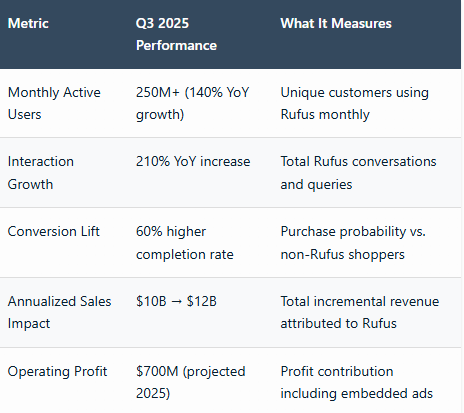
The 60% Conversion Lift: Amazon's Most Important Stat
While the $10 billion figure grabs headlines, the 60% conversion lift is actually more significant for understanding Rufus's economic impact. This metric compares purchase completion rates between customers who used Rufus during their shopping session versus those who didn't.
The conversion lift isn't uniform across all product categories. In our analysis of Rufus behavior patterns across multiple client accounts, we've observed that complex purchases (electronics, appliances, technical products) show the highest conversion lifts, sometimes exceeding 80%. Simple replenishment purchases show smaller but still measurable improvements.
Hidden Metrics: What Amazon Tracks But Doesn't Publicize
Beyond the publicly disclosed figures, Amazon tracks several additional metrics for internal optimization:
Response accuracy rates: How often Rufus provides correct product recommendations
Follow-up question frequency: Indicators of conversation quality
Abandonment patterns: When customers stop using Rufus mid-journey
Cross-category navigation: How Rufus drives discovery beyond initial queries
Seller impact distribution: Which sellers benefit most from Rufus traffic
Traditional vs. Rufus Attribution Models
To understand why Amazon needed a new attribution approach for Rufus, it helps to compare it against traditional Amazon attribution methodologies:
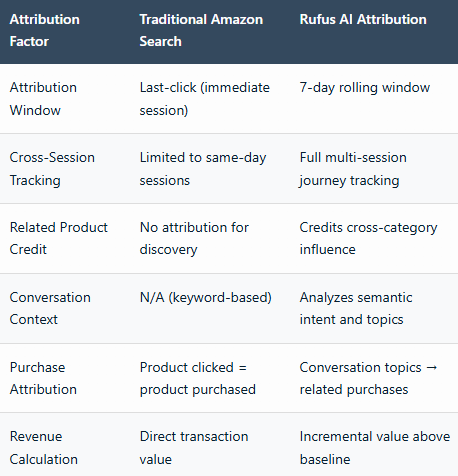
The "Incremental" Revenue Challenge
One critical aspect of Amazon's attribution methodology is that the $10 billion figure represents incremental revenue, not total sales. This means Amazon is attempting to isolate purchases that wouldn't have occurred without Rufus assistance.
Calculating incrementality requires establishing baseline behavior. Amazon likely uses control groups of similar customers who don't have Rufus access to estimate what those 250 million users would have purchased anyway. The difference between Rufus users' actual purchases and the control group's behavior becomes the incremental impact.
This is mathematically sophisticated but introduces assumptions. Some industry analysts have questioned whether Amazon's incrementality calculations fully account for purchase timing shifts (buying today vs. tomorrow) versus truly new demand.
What This Means for Amazon Sellers
Understanding Amazon's attribution model isn't just academic curiosity. The methodology directly influences which products Rufus recommends and how sellers should optimize their listings.
Attribution Creates Optimization Opportunities
Because Amazon attributes revenue to conversations rather than just clicks, product content that helps Rufus understand your product's use cases, benefits, and context becomes critical. A well-optimized listing might not rank #1 in traditional search but could dominate Rufus recommendations for specific customer questions.
The 7-day attribution window also means that product visibility in Rufus conversations can drive sales days later. Your product doesn't need to close the sale immediately; it just needs to enter the customer's consideration set during the Rufus interaction.
The Content Quality Signal
Amazon's attribution models undoubtedly feed back into Rufus's recommendation algorithms. Products that show high conversion rates within the 7-day attribution window likely receive preferential treatment in future Rufus responses. This creates a reinforcing cycle where optimization improvements compound over time.
Key Insight: Amazon's attribution methodology rewards listings that help customers make informed decisions, not just listings that drive immediate clicks. This favors comprehensive, contextual content over keyword-stuffed bullet points.
Ad Revenue Integration
The $700 million operating profit projection includes revenue from advertisements embedded in Rufus responses. Amazon has confirmed that Sponsored Products can appear within Rufus conversations, creating a new attribution channel for PPC campaigns.
This means sellers running Amazon Ads need to consider how their campaigns interact with Rufus attribution. A Sponsored Product click during a Rufus session might receive credit both for direct conversion and for influencing downstream purchases within the 7-day window.
Frequently Asked Questions
How does Amazon's 7-day rolling attribution work for Rufus?
Amazon tracks every Rufus conversation and monitors related purchases for seven days afterward. Sales of products discussed with Rufus within that window receive attribution credit, even if the purchase happens days later or includes related items.
What does "downstream impact" mean in Amazon's Rufus metrics?
Downstream impact measures total revenue influenced by Rufus interactions, including immediate purchases, delayed conversions, and related cross-category sales. It captures the full economic ripple effect of AI-assisted shopping rather than just direct clicks.
Why do Rufus users convert 60% more than regular shoppers?
Rufus provides contextual product recommendations, answers specific questions, and helps customers make informed decisions. This reduces purchase friction and buyer uncertainty, leading to higher completion rates compared to traditional keyword search and manual browsing.
Can sellers see their Rufus attribution metrics in Seller Central?
No, Amazon doesn't currently provide seller-level Rufus attribution data in Seller Central. The $10B figure and underlying metrics are disclosed only at the company level during earnings calls and internal planning documents.
How does Rufus attribution differ from Amazon Attribution for external traffic?
Amazon Attribution for external traffic uses a 14-day last-click model. Rufus attribution uses a 7-day rolling window with semantic relevance scoring, tracking conversation context rather than just clicks, and crediting cross-category influence.
Does Amazon track Rufus attribution at the ASIN level?
Yes, Amazon's internal systems track which specific ASINs are discussed in Rufus conversations and which products convert within attribution windows. This data informs Rufus recommendation algorithms but isn't currently shared with sellers publicly.
What's the difference between total sales and incremental sales for Rufus?
Total sales include all purchases by Rufus users. Incremental sales isolate purchases that wouldn't have happened without Rufus assistance, calculated by comparing Rufus users against control groups to establish baseline behavior.
How does Amazon prevent double-counting in Rufus attribution models?
Amazon uses probabilistic attribution models that assign fractional credit when multiple touchpoints influence a purchase. Machine learning algorithms determine attribution confidence based on semantic relevance between conversations and eventual purchases.
Can Rufus attribution credit span multiple product categories?
Yes, Amazon's downstream impact methodology explicitly tracks cross-category influence. If a Rufus conversation about camping tents leads to purchases of sleeping bags and cookware, all items receive attribution credit within the window.
Will Amazon eventually share Rufus attribution data with sellers?
Amazon hasn't announced plans to share Rufus attribution metrics publicly. However, given Amazon Attribution's evolution for external traffic, similar reporting capabilities for Rufus interactions are likely in development for Brand Registry participants.
Key Takeaways
Amazon uses a 7-day rolling attribution window to capture delayed conversions and cross-category influence from Rufus interactions, moving beyond simple last-click attribution.
The "downstream impact" methodology tracks $10B+ in incremental revenue by measuring purchases that wouldn't have occurred without AI-assisted shopping guidance.
Rufus users convert at 60% higher rates than non-Rufus shoppers, demonstrating measurable impact on purchase completion behavior.
Attribution credits extend to related products discovered through Rufus conversations, not just items explicitly discussed during AI interactions.
Amazon's calculation of incremental revenue uses control groups to isolate Rufus's true impact above baseline shopping behavior.
The attribution model feeds back into Rufus recommendation algorithms, creating reinforcing cycles where well-optimized listings gain increasing visibility over time.
Sellers don't currently have access to ASIN-level Rufus attribution data, though Amazon tracks this internally for algorithm optimization.
The $700M operating profit projection includes revenue from advertisements embedded within Rufus conversations, creating new PPC attribution channels.
References
Amazon (2024).Amazon Rufus: AI Shopping Assistant Launch Announcement. About Amazon. https://www.aboutamazon.com/news/retail/amazon-rufus
Amazon (2025).Amazon Rufus AI Assistant Gets Smarter with Personalized Shopping Features. About Amazon. https://www.aboutamazon.com/news/retail/amazon-rufus-ai-assistant-personalized-shopping-features
Lombardo, C. (2025).Amazon Says Its AI Shopping Assistant Rufus Is So Effective It's On Pace to Pull In an Extra $10 Billion in Sales. Fortune. https://fortune.com/2025/11/02/amazon-rufus-ai-shopping-assistant-chatbot-10-billion-sales-monetization/
Amazon Q3 2025 Earnings Call (2025). CEO Andy Jassy disclosure of Rufus performance metrics and revenue projections.
Business Insider (2025). Reporting on Amazon internal planning documents projecting Rufus operating profit contributions.
Disclaimer: This analysis is based on publicly disclosed information from Amazon earnings calls, official announcements, and industry reporting. Amazon's internal attribution methodologies may include additional factors not disclosed publicly. Revenue figures represent Amazon's calculations of incremental sales attributed to Rufus interactions. Individual seller results will vary based on product category, listing quality, and competitive dynamics.
