
The Rufus Paradox: Why “Better” Listings Get Worse Visibility (Case Study: 47% Traffic Drop)
The Rufus Paradox: Why "Better" Listings Get Worse Visibility
Quick Answer Sellers who fully rewrite listings for Rufus AI often see organic A9 traffic drop 30–50%. The mechanism: AI-first copy disrupts keyword density signals A9 still relies on, creates semantic mismatches with buyer intent, and triggers Rufus to weaponize negative review content rather than listing copy.
Table of Contents
Two Ranking Systems, One Listing
The Four Mechanisms Behind the Traffic Drop
Rufus vs. A9: What Each System Actually Evaluates
How to Diagnose a Rufus Paradox in Your Account
The Fix: Dual-Layer Optimization
Frequently Asked Questions
Key Takeaways
References
There's a pattern showing up in accounts that have diligently followed Rufus optimization advice. Sellers rewrite their listings using conversational language, strip out the old keyword-dense copy, add benefit-forward bullet points, clean up the title. The listing looks better. Reads better. And then organic traffic craters.
This isn't a fringe complaint. The core problem is a fundamental architecture conflict that most Rufus content completely ignores: Amazon runs two distinct ranking systems simultaneously, and optimizing hard for one actively degrades performance in the other.
Two Ranking Systems, One Listing
When a shopper types a query into the Amazon search bar and hits enter, A9 is ranking results. A9 still relies heavily on keyword presence, exact match frequency, and click-through signals. It is not a conversational system. It does not interpret intent. It matches terms.
When that same shopper taps the Rufus button and asks "what's the best protein powder for muscle recovery without a lot of sugar,"Rufus/Cosmo is doing the ranking. As documented in Amazon's official technical overview of Rufus, the system uses semantic similarity models and RAG (retrieval-augmented generation) rather than keyword matching. It processes product attributes, reviews, and Q&A at the same time.
Here's the collision point: the copy choices that help Rufus understand your product often directly reduce the keyword signal density that A9 needs to rank you in traditional search. You're not writing one listing anymore. You're being asked to satisfy two systems with different — and sometimes opposing — requirements.
As we've explored in depth in our breakdown of how Rufus and A9 evaluate ranking factors differently, the gap between these two systems is wider than most sellers realize. Understanding that gap is the starting point for resolving the paradox.
The Four Mechanisms Behind the Traffic Drop
1. Keyword Density Collapse
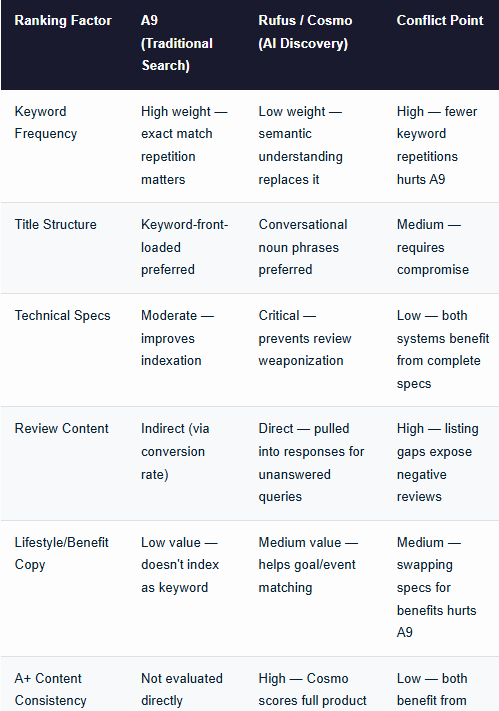
Traditional Amazon SEO built listings around phrase frequency. The old-school playbook called for exact-match keywords in the title, first bullet, and description. When sellers shift to conversational copy for Rufus, they naturally write fewer keyword repetitions. Sentences like "The orthopedic memory foam dog bed supports joint health during sleep" contain the keyword once; an A9-optimized title might pack the same phrase three times in different combinations.
A9's indexing still rewards frequency signals for certain head terms. A listing that drops from four instances of a high-volume keyword to one will typically see ranking degradation for that term within days of the edit. The traffic numbers follow shortly after.
What this looks like in practice: Sellers report a 30–50% organic traffic drop in the first 4–6 weeks after a full Rufus rewrite. The Rufus-influenced session share may not compensate because Rufus traffic is still building attribution while A9 traffic loss is immediate.
2. Review Weaponization
This is the mechanism that catches sellers most off guard. When Rufus can't find a clear answer to a buyer's question in your listing copy, it goes looking in your reviews and Q&A section. This is documented behavior — Amazon's own Rufus announcement describes the assistant drawing from the "full depth" of catalog data including reviews.
If a shopper asks "does this coffee maker have a strong enough pump for espresso?" and your listing doesn't address pump pressure, Rufus will pull from your customer reviews to answer. If even 2–3 reviews mention weak extraction or disappointing crema, Rufus will surface that. Conversational Rufus-optimized copy that skips technical specs to focus on lifestyle benefits leaves more surface area for negative review content to fill the gap.
The irony: sellers who left technical spec language in their listings (the old "keyword stuffing" that Rufus advice said to remove) have implicit protection here. Their listing answers the technical question before Rufus needs to go hunting in the reviews. This connects to patterns we've documented in our analysis of the 12 product attributes that trigger Rufus suppression — gaps in attribute coverage are where the system turns to potentially damaging review content.
3. Semantic Mismatch With Buyer Intent
Rufus uses a semantic similarity model — specifically S-BERT embeddings — to match product attributes against user queries. According to Amazon's WSDM 2025 research on Subjective Product Needs, the system processes queries across five dimensions: subjective properties, events, activities, goals, and target audiences. When a listing rewrites skew too heavily toward lifestyle benefits ("perfect for your morning routine"), they lose the attribute-level specificity that Rufus needs for this five-dimensional matching.
A buyer asking "stainless steel travel mug that fits in a car cup holder and keeps coffee hot for six hours" will get matched against the attribute layer of the product catalog, not the lifestyle narrative. Listings that have replaced precise product attributes with benefit language perform worse in this matching layer, not better.
4. A+ Content and Title Misalignment
When sellers rewrite the main listing copy for Rufus but leave A+ content and brand story unchanged, Cosmo detects inconsistency across the product record. As covered in our deep dive into Cosmo's backend data model, the system evaluates the full structured data record including A+ modules, not just the text fields visible in the listing. Inconsistent terminology between the new conversational listing and the old spec-heavy A+ content creates a fractured product record that neither system ranks confidently.
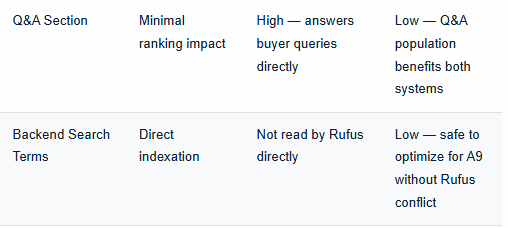
Rufus vs. A9: What Each System Actually Evaluates
How to Diagnose a Rufus Paradox in Your Account
If you're seeing unexplained organic traffic declines after a listing update in the last 90 days, these are the signals worth checking:
Check your keyword rank movement for exact-match head terms. Pull a keyword rank history from your tracking tool for the 5–10 highest-volume keywords on the ASIN. If multiple head terms dropped simultaneously with the listing change, keyword density collapse is the likely culprit rather than algorithm changes.
Test your listing's Rufus response on critical product questions. Open Rufus on mobile, ask 3–5 questions about your product that your listing doesn't explicitly answer. If Rufus is pulling from your review section to answer (you'll see review excerpts in the response), you have review weaponization exposure. The fix is adding the specific answer to your listing, not removing negative reviews.
Audit your A+ content against your current listing language. If your bullet points use different terminology than your A+ modules for the same product attributes, Cosmo is seeing a fractured product record. This is particularly common when sellers update listing copy but leave A+ content from a previous creative refresh untouched.
The attribution model compounds this diagnostic challenge. As we outlined in our analysis of how Amazon tracks Rufus-influenced revenue, approximately 70% of Rufus-assisted sales appear as delayed purchases in 7-day attribution windows. This means Rufus gains can be invisible in the short term while A9 losses show up immediately in sessions and orders.
The Fix: Dual-Layer Optimization
The answer isn't to abandon Rufus optimization. It's to stop treating it as a full listing rewrite and instead build two content layers within the same listing structure.
Layer 1 — A9 Keyword Infrastructure (preserves organic ranking): Your title should retain exact-match keyword presence for your top 2–3 head terms. These don't have to look like keyword stuffing; they can be embedded naturally. Backend search terms should be fully populated with long-tail variations. Bullet point 1 should front-load the primary keyword phrase in the first 5 words.
Layer 2 — Rufus Attribute Coverage (prevents review weaponization and improves semantic matching): Rather than rewriting bullets to sound conversational, add a Q&A block that directly answers the 5 questions most commonly asked about your product type in Rufus. Populate the product attributes section completely — Cosmo reads 18 structured fields before examining your title copy. Ensure every material claim, technical specification, and compatibility detail is in the listing rather than only in your A+ content.
The practical rule: Conversational language belongs in your Q&A section and A+ benefit copy. Keyword infrastructure belongs in your title and first bullet. Technical specs belong everywhere — they protect you in A9 indexation and protect you from review weaponization in Rufus simultaneously.
In our work with 7-figure sellers at Atomic, we've seen the best outcomes when Rufus optimization is additive rather than replacement-based. Sellers who add a targeted Q&A section and complete the structured data fields — without removing their existing A9 keyword infrastructure — typically see Rufus visibility improve without the organic traffic penalty. That approach directly addresses the mechanism behind what we've called the conversion rate problem hidden in Rufus optimization: the problem isn't optimization itself, it's optimization that removes the scaffolding the rest of the system depends on.
The sellers who are navigating this cleanly understand that Rufus is not a replacement discovery channel — it's an additional layer. The external authority signals that drive Rufus recommendations at the brand level are covered in detail in our piece on how external citations are replacing listing copy as the primary trust signal for AI-assisted shopping.
Frequently Asked Questions
Why does optimizing for Rufus sometimes hurt organic Amazon search rankings?
Rufus and A9 have opposing requirements. A9 rewards keyword frequency; Rufus uses semantic matching. Rewrites that reduce exact-match keyword density for conversational copy directly degrade A9 ranking signals, causing organic traffic drops.
What is review weaponization and how does it happen?
When your listing doesn't answer a buyer's question, Rufus pulls answers from your customer reviews. If negative reviews address that gap, Rufus surfaces them in its response — turning your review section against your listing visibility and conversions.
Can I optimize for both A9 and Rufus in the same listing?
Yes. Keep A9 keyword infrastructure in your title and first bullet. Add Rufus-specific content in Q&A sections and complete structured product attributes. Avoid full rewrites that replace keyword copy entirely.
How many structured fields does Cosmo evaluate before reading your title?
Cosmo processes 18 structured backend fields — including item type, material, target audience, and compatibility — before examining title or bullet copy. Incomplete attributes are a primary ranking gap.
How quickly does a listing rewrite affect A9 rankings?
A9 keyword rank degradation typically appears within 3–10 days of a listing update. Rufus attribution gains show up over a 7-day rolling window, meaning A9 losses are often visible before Rufus benefits register.
Does Rufus read backend search terms?
No. Backend search terms feed A9 indexation only. Rufus reads product attributes, listing copy, review content, Q&A, and structured data — not the backend search term fields in Seller Central.
What content protects against review weaponization?
Proactively answering common buyer questions in your listing copy and Q&A section removes the gap that triggers Rufus to search reviews. Technical specs and compatibility details are the highest-risk gaps to leave unaddressed.
Is A+ content evaluated by Rufus and Cosmo?
Yes. Cosmo evaluates the full product record including A+ modules. Inconsistent terminology between your main listing and A+ content signals a fractured product record that reduces confidence scoring in both systems.
How does Rufus attribute sales differently from traditional metrics?
Rufus uses a 7-day attribution window where approximately 70% of influenced revenue comes from delayed purchases. Traditional last-click metrics miss most Rufus-assisted sales, making the channel appear less effective than it is.
What is the safest way to test Rufus optimization without risking A9 traffic?
Test on lower-volume ASINs first. Add Q&A content and complete structured attributes without changing title or bullet keyword structure. Monitor A9 rank for head terms over 14 days before applying changes to top-performing ASINs.
Key Takeaways
Amazon runs two distinct ranking systems simultaneously. A9 relies on keyword frequency; Rufus/Cosmo uses semantic matching. A listing that's "better" for one is often worse for the other.
Sellers who fully replace keyword copy with conversational language typically see organic A9 traffic drop 30–50% within 4–6 weeks of the rewrite.
Review weaponization is the hidden risk: when your listing leaves questions unanswered, Rufus fills the gap with review content — including negative reviews.
Cosmo processes 18 structured backend fields before reading your title copy. Incomplete product attributes are a more critical gap than copy style.
The fix is additive, not replacement-based: build a Q&A layer and complete structured attributes without removing the A9 keyword infrastructure already working.
Rufus attribution runs on a 7-day rolling window. A9 traffic losses are immediate. Test on low-volume ASINs before touching top performers.
Backend search terms are invisible to Rufus. Populate them fully for A9 without worrying about Rufus conflicts — that's your lowest-risk optimization lever.
References
Amazon Science. "The technology behind Amazon's generative AI-powered shopping assistant Rufus." Amazon.science, 2024. amazon.science/blog/the-technology-behind-amazons-genai-powered-shopping-assistant-rufus
About Amazon. "Introducing Rufus, Amazon's expert AI personal shopping assistant." About Amazon, September 2023. aboutamazon.com/news/retail/amazon-rufus
Dammu, P.P.S., Alonso, O., & Poblete, B. "A shopping agent for addressing subjective product needs." Proceedings of WSDM 2025, ACM.doi.org/10.1145/3701551.3704124
AWS Machine Learning Blog. "How Rufus scales conversational shopping to millions." AWS Blog, 2024. aws.amazon.com/blogs/machine-learning/how-rufus-scales-conversational-shopping
Amazon Seller Central. "Product detail pages — listing quality guidelines." Seller Central Help. sellercentral.amazon.com/help/hub/reference/external/200270100
Disclaimer: Technical claims in this article are based on published Amazon Science research, official Amazon documentation, and observed patterns across seller accounts. Amazon's AI systems are updated continuously; specific behavior may vary by category and marketplace. Always test changes on individual ASINs before applying broadly.
