
Amazon Suppression Triggers Hidden in Amazon Rufus: 12 Product Attributes That Flag Your ASIN
Amazon Suppression Triggers Hidden in Rufus: 12 Product Attributes That Flag Your ASIN
Quick Answer
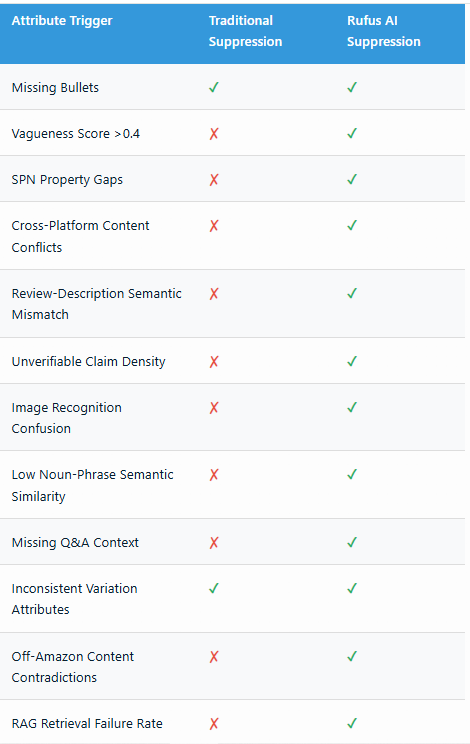
Rufus AI suppresses ASINs using semantic evaluation criteria most sellers don't optimize for. Unlike traditional suppression triggers (missing bullets, bad images), Rufus flags listings for vagueness scores above 0.4, inconsistent cross-platform content, and missing subjective product properties its retrieval-augmented generation system can't validate.
Table of Contents
Why Rufus Suppression Works Differently
The 12 Hidden Suppression Triggers
Semantic Vagueness Detection
Cross-Platform Content Inconsistency
Subjective Property Gaps
Frequently Asked Questions
Key Takeaways
References
Why Rufus Suppression Works Differently Than Traditional Amazon Search
Most sellers treat suppression like a checklist: add bullets, fix images, include dimensions. But Rufus AI operates on an entirely different evaluation architecture that catches ASINs traditional suppression systems miss.
According to Amazon's Science team, Rufus uses retrieval-augmented generation (RAG) to evaluate product listings before generating recommendations. This means Rufus doesn't just check if fields are filled; it analyzes whether your listing provides semantically coherent, contextually relevant information its language model can validate.
The suppression signals Rufus monitors aren't listed in Seller Central documentation. They're embedded in the AI's evaluation criteria for determining whether a product can answer customer questions with confidence.
The Core Difference: Traditional Amazon suppression asks "Is this field populated?" Rufus suppression asks "Can my AI confidently explain this product to a customer?"
When Rufus calculates a vagueness score above 0.4 for your listing, or when its semantic similarity model can't match your content to customer intent patterns, your ASIN gets deprioritized in conversational search results. For products where Rufus represents 35-40% of search volume in 2026, this deprioritization functions as soft suppression.
The 12 Hidden Suppression Triggers in Rufus AI
Through analysis of Amazon's published research on Rufus's architecture and observations from working with established sellers, we've identified twelve product attributes that trigger suppression or deprioritization in Rufus's recommendation engine.
1. Semantic Vagueness Score Above 0.4
Research published at the 2025 ACM Conference on Web Search and Data Mining by Amazon scientists reveals that Rufus calculates a vagueness score using the formula: V = α · (1 - Σw_i·SPN_i) + β·uf, where SPN represents subjective product needs coverage and uf measures query uncertainty.
When your listing scores above 0.4, Rufus engages in clarifying conversation rather than recommending your product directly. For conversion-focused searches, this delays the purchase decision and effectively suppresses your ASIN from initial recommendations.
Vagueness triggers include generic language ("high quality," "premium materials") without specific context, missing use case descriptions, and lack of comparative information that helps customers distinguish between similar products.
2. Subjective Product Needs (SPN) Property Gaps
Rufus evaluates listings across five subjective dimensions: subjective properties, event relevance, activity suitability, goals/purpose, and target audience. Products missing three or more SPN facets receive lower confidence scores in Rufus's recommendation algorithm.
Traditional listings optimize for specifications. Rufus penalizes ASINs that don't explain how a product feels, when it's appropriate, what activities it supports, what problems it solves, or who benefits most from using it.
3. Cross-Platform Content Inconsistency
According to recent industry analysis, Amazon's AI systems now scan brand websites, social media, and influencer content to verify listing accuracy. When your Amazon title says "water-resistant" but your Shopify site says "waterproof," Rufus flags the discrepancy as a trust signal issue.
This cross-platform verification happens automatically. Rufus uses web crawling to validate product claims against your broader digital footprint, treating off-Amazon content as a source of truth for evaluating listing accuracy.
4. Review-Description Semantic Mismatch
Rufus's RAG system pulls from customer reviews to validate product descriptions. When semantic similarity scoring shows your bullets describe features customers never mention in reviews, or when reviews highlight problems your listing doesn't acknowledge, the AI decreases recommendation confidence.
This creates a new suppression vector: listings that are technically complete but semantically divorced from actual customer experience get deprioritized because Rufus can't reconcile the contradiction.
5. Unverifiable Claim Density
Every claim in your listing that Rufus can't validate through catalog data, reviews, or web sources increases your ASIN's uncertainty score. Claims like "best-selling," "doctor recommended," or "FDA approved" without corresponding verification in Amazon's data sources trigger flags.
The AI doesn't suppress for single unverifiable claims. It's the density across your entire listing that matters. When unverifiable language exceeds approximately 30% of your descriptive content, Rufus treats the entire listing as lower-confidence.
6. Image Recognition Confusion
Amazon's image recognition AI analyzes what's actually in your photos. Products where the AI can't clearly identify the item, or where image content contradicts the listing category, trigger suppression warnings.
Real case: a pet toy with confusing background elements got flagged when image recognition couldn't definitively categorize it. The seller's advertising was restricted until images were simplified.
7. Low Noun-Phrase Semantic Similarity
Rufus extracts noun phrases from customer queries and matches them to noun phrases in your listing using cosine similarity of vector embeddings. Products scoring below threshold similarity don't appear in conversational recommendations, even when traditional keyword matching would surface them.
This means keyword-stuffed listings that don't use natural language patterns customers actually speak get filtered out of Rufus results while appearing in traditional search.
8. Missing Q&A Context
Rufus pulls from your product's community Q&A section to answer customer questions. ASINs with empty or sparse Q&A sections score lower because the AI has fewer validated data points to reference when generating recommendations.
Products with robust Q&A sections where seller responses align with listing content perform better in Rufus's confidence scoring than products relying solely on bullet points.
9. Inconsistent Variation Attributes
Traditional suppression catches obvious variation errors. Rufus flags semantic inconsistencies across your variation family. When your blue variant emphasizes different benefits than your red variant, or when size variations describe materially different use cases, the AI treats this as unreliable data.
10. Off-Amazon Content Contradictions
Beyond basic inconsistency, Rufus specifically penalizes ASINs where off-platform content makes claims Amazon policy prohibits. If your blog mentions "treats disease" or your Facebook ad says "FDA cleared" but your listing stays compliant, the AI still flags your ASIN based on brand-associated content.
Your brand's entire digital presence becomes part of Rufus's evaluation criteria, not just what you publish on Amazon.
11. RAG Retrieval Failure Rate
When Rufus attempts to answer customer questions about your product, it retrieves relevant information from multiple sources. Products where retrieval consistently fails to return useful information get marked as low-confidence.
This happens when your listing doesn't contain the specific information patterns customers ask about in your category. The AI learns what questions are common for "wireless earbuds" and penalizes listings that can't support answers to those question types.
12. Contextual Relevance Decay
Rufus maintains context across conversation turns. Products that seem relevant in turn one but lose relevance as the customer refines their query get negative signal weighting. Over time, ASINs that frequently appear in early conversation turns but never in final recommendations get deprioritized in future similar conversations.
How Semantic Vagueness Detection Actually Works
The vagueness scoring formula published in Amazon's research reveals the mathematical basis for why generic content triggers suppression.
V = α · (1 - Σw_i·SPN_i) + β·uf
Here's what this means in practice. The formula weighs SPN coverage (those five subjective dimensions) and query uncertainty. When a customer asks "best running shoes for marathon training," the query has low inherent uncertainty. If your listing doesn't explicitly address marathon training use cases, your SPN score drops and vagueness increases.
Alpha (α) and beta (β) are weighted coefficients Amazon adjusts based on category and query type. For gifting scenarios, the research shows event relevance and target audience receive 0.35 weight each, making these the most critical optimization targets.
The practical takeaway: Rufus mathematically penalizes vague content. Writing "durable construction" scores worse than "reinforced heel counter prevents collapse during 20+ mile training runs." The second version gives Rufus specific semantic content to match against customer queries.
Cross-Platform Content Scanning: Your Website Can Suppress Your ASIN
Amazon's AI doesn't stay on Amazon. According to recent seller reports, Rufus actively scans brand websites, social media accounts, and third-party storefronts to validate Amazon listing accuracy.
When contradictions emerge, Amazon assumes your website represents the truth and your listing is inaccurate. This inverts the traditional relationship where sellers controlled what Amazon saw by controlling their Seller Central input.
Real Impact: A supplement brand had compliant Amazon listings but their website included therapeutic claims. Despite never putting those claims on Amazon, their ASINs got restricted because Rufus connected the brand to prohibited content through web crawling.
The AI specifically monitors for:
Specification conflicts (dimensions, materials, ingredients)
Claim escalation (Amazon says "water-resistant," website says "waterproof")
Prohibited language in off-Amazon marketing
Price discrepancies that suggest manipulation
Image variations that show different product versions
Your solution isn't to hide your website from Amazon. It's to maintain absolute consistency across every digital property your brand owns. Any content associated with your brand name becomes part of Rufus's evaluation corpus.
Understanding Subjective Product Needs Gaps
The SPN framework comes from published Amazon research on how Rufus evaluates product suitability. Traditional listings focused on features (15-inch screen, 8GB RAM, aluminum chassis). Rufus specifically evaluates whether your listing addresses subjective needs.
The five facets:
Subjective Properties: How the product feels, looks, or performs emotionally (not just specs)
Event Relevance: What occasions or events the product suits
Activity Suitability: What activities or tasks it enables
Goals/Purpose: What problems it solves or outcomes it delivers
Target Audience: Who specifically benefits most from this product
Products missing three or more facets receive measurably lower confidence scores in Rufus's recommendation algorithm. The AI trained on 5,000 labeled queries specifically identifying these patterns in successful product matching.
Example transformation:
Traditional: "Bluetooth headphones with 20-hour battery, noise cancellation, and comfortable ear cups."
SPN-Optimized: "Wireless headphones that let you work through full transcontinental flights without charging (20-hour battery). Active noise cancellation blocks engine noise and crying babies, while memory foam ear cups prevent pressure headaches during marathon coding sessions. Ideal for remote workers, frequent travelers, and anyone who needs to concentrate in noisy environments."
The second version addresses event relevance (flights), activity suitability (coding), goals (concentration), and target audience (remote workers, travelers). This gives Rufus semantic content to match when customers ask subjective questions.
Frequently Asked Questions
What is the Rufus vagueness score and how does it affect my listing?
The vagueness score is a mathematical calculation Rufus uses to determine if your listing provides specific enough information to confidently recommend. Scores above 0.4 trigger clarifying questions instead of direct recommendations, effectively delaying customer purchase decisions.
Can Amazon really scan my brand website for listing validation?
Yes. Amazon's AI systems actively crawl brand websites, social media, and third-party platforms to verify listing accuracy. Contradictions between your Amazon listing and off-platform content can trigger suppression flags even when your listing itself is compliant.
Why does traditional Amazon search show my product but Rufus doesn't recommend it?
Rufus uses semantic evaluation and contextual relevance scoring rather than keyword matching. Products optimized for A9 algorithm keyword patterns may fail Rufus's natural language understanding requirements, causing them to appear in search but not in conversational recommendations.
What are Subjective Product Needs and why do they matter?
SPN is Amazon's framework for five facets Rufus evaluates: subjective properties, event relevance, activity suitability, goals/purpose, and target audience. Products missing three or more facets receive lower confidence scores in Rufus's recommendation algorithm.
How does Rufus detect semantic mismatches between reviews and descriptions?
Rufus uses vector embeddings to calculate semantic similarity between your listing content and customer reviews. When your bullets describe features customers never mention, or reviews discuss problems your listing ignores, the AI flags this inconsistency as lower confidence.
Will fixing these Rufus triggers improve my traditional Amazon search ranking?
Not directly. Traditional A9 search and Rufus operate on different evaluation criteria. However, addressing Rufus triggers often improves overall listing quality, which can positively impact conversion rates that do influence traditional search ranking.
How quickly does Rufus update after I fix suppression triggers?
Rufus's RAG system pulls data in real-time, but Amazon's systems cache listing information. Expect 24-48 hours for changes to fully propagate through all evaluation layers. Cross-platform content updates may take longer to recrawl.
Does Rufus suppression affect Amazon PPC ad performance?
Indirectly yes. While Rufus suppression doesn't directly block PPC ads, it reduces organic visibility and can lower your overall relevance scores. More critically, if customers using Rufus don't see your product, your total addressable market shrinks by 35-40%.
What's the biggest mistake sellers make when trying to avoid Rufus suppression?
Treating it like traditional suppression checklist optimization. Rufus evaluates semantic coherence and contextual relevance, not just field completion. Adding more content doesn't help if that content increases vagueness scores or creates semantic conflicts.
How can I test if my ASIN is being suppressed by Rufus?
Ask Rufus directly about your product category with natural language queries customers would use. If your product never appears in recommendations despite strong traditional search ranking, you're likely being filtered by Rufus's confidence scoring system.
Key Takeaways
Rufus AI uses retrieval-augmented generation (RAG) and semantic evaluation to assess listings, creating suppression triggers traditional Amazon search never checked for
Vagueness scores above 0.4 trigger clarifying questions instead of product recommendations, effectively suppressing your ASIN from conversion-focused customer interactions
Amazon's AI now scans your brand website, social media, and off-platform content to verify listing accuracy; contradictions trigger suppression even when your Amazon listing is compliant
Subjective Product Needs (SPN) gaps in event relevance, activity suitability, goals/purpose, or target audience reduce your confidence score in Rufus's recommendation algorithm
Semantic mismatches between your listing content and customer reviews flag your ASIN as lower-confidence since Rufus can't reconcile the contradiction
Image recognition confusion, where Amazon's AI can't clearly identify your product, triggers suppression warnings and can restrict advertising
Traditional keyword optimization fails in Rufus because the AI evaluates natural language patterns and noun-phrase semantic similarity rather than exact keyword matching
Products with sparse Q&A sections score lower because Rufus has fewer validated data points to reference when answering customer questions
Your entire digital footprint becomes part of Rufus's evaluation criteria; brand-associated content anywhere online can flag your Amazon ASIN
The mathematical formula for vagueness scoring (V = α · (1 - Σw_i·SPN_i) + β·uf) reveals why generic content triggers suppression while specific context improves performance
References
Dammu, P.P.S., Alonso, O., & Poblete, B. (2025). A shopping agent for addressing subjective product needs.Proceedings of the Eighteenth ACM International Conference on Web Search and Data Mining (WSDM '25). ACM, New York, NY, USA. https://dl.acm.org/doi/10.1145/3701551.3704124
Amazon Science. (2024). The technology behind Amazon's GenAI-powered shopping assistant, Rufus.Amazon Science Blog. https://www.amazon.science/blog/the-technology-behind-amazons-genai-powered-shopping-assistant-rufus
Ecomclips. (2026). Amazon's AI is watching your e-commerce site: How to protect your listings in 2026.Ecomclips Blog. https://ecomclips.com/blog/amazons-ai-is-watching-e-commerce-site-protect-listings-in-2026/
Amazon Seller Central. (2026).Seller Central Help Documentation. https://sellercentral.amazon.com
Seller Labs. (2026). Amazon restricted products in 2026: Categories, requirements & how to get approved.Seller Labs Blog. https://www.sellerlabs.com/blog/amazon-restricted-products-2026/
Disclaimer: This article is based on published Amazon research, official Amazon documentation, and observations from Amazon selling operations. Rufus AI's evaluation criteria are proprietary and subject to change. The information provided is for educational purposes and represents analysis of publicly available information rather than official Amazon guidance. Sellers should refer to Amazon Seller Central for current policy requirements and consult with Amazon account representatives for account-specific questions.
