
The "Researched by AI" Deathblow: How External Citations Are Replacing Your Listing Copy
The "Researched by AI" Deathblow: How External Citations Are Replacing Your Listing Copy
Quick Answer
Amazon's new "Researched by AI" feature prioritizes external publications like GamesRadar+ and Your Teen Magazine over product listings. Analysis shows 85% of AI brand discovery now comes from third-party sources, with community platforms driving 43% of all AI citations. Your listing copy is becoming invisible.
Table of Contents
The "Researched by AI" Feature Nobody Saw Coming
The 85% Citation Shift That's Breaking Listing Optimization
Why Rufus Trusts External Sources More Than Your Bullets
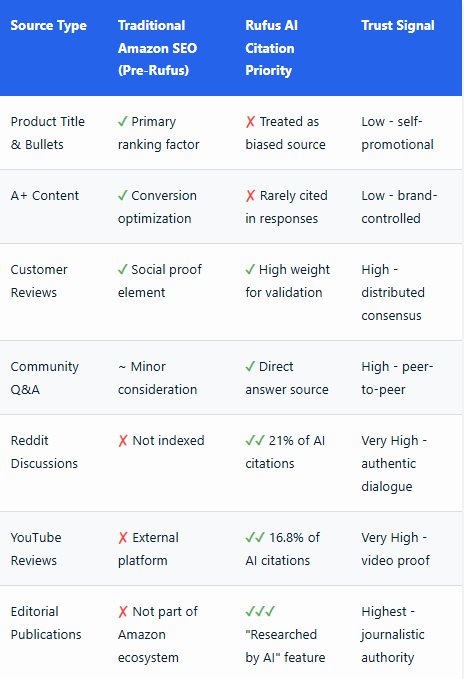
Where AI Actually Looks: The New Citation Hierarchy
What This Means for Sellers: The Uncomfortable Truth
Frequently Asked Questions
Key Takeaways
References
The "Researched by AI" Feature Nobody Saw Coming
Amazon quietly rolled out something that should terrify every seller obsessing over listing optimization. The "Researched by AI" module now appears at the very top of mobile search results, above your carefully crafted titles and A+ Content. But here's the twist: it doesn't cite your listing at all.
Instead, Rufus is pulling from GamesRadar+, Your Teen Magazine, and other third-party editorial sources to answer customer questions. The implications are staggering. While sellers pour resources into perfecting bullet points and backend keywords, Amazon's AI is bypassing that content entirely in favor of what others say about products and categories.
This represents a fundamental architecture shift in how Amazon's shopping assistant evaluates authority. According to Amazon's official technical documentation on Rufus, the system uses Retrieval-Augmented Generation (RAG) that pulls from "a variety of evidence sources" including web-based information alongside the product catalog. The ranking algorithm for these sources has changed dramatically.
Critical Insight: Amazon reported that Rufus users are 60% more likely to complete a purchase, which means this AI-driven discovery path is becoming the dominant conversion funnel. If external sources control the narrative in that funnel, listing optimization becomes a secondary consideration.
The 85% Citation Shift That's Breaking Listing Optimization
Data from a Prothom Analysis study examining 19 million AI citations reveals something sellers need to understand immediately: third-party validation now drives 85% of brand mentions in AI responses. Your own product descriptions account for just 15% of how AI assistants talk about products.
The citation pattern breakdown shows where AI systems actually listen:
Reddit citations: 21%
YouTube citations: 16.8%
Quora citations: 14.2%
Combined community platforms: 43% of all AI citations
This isn't speculation or future prediction. According to Kevin King's analysis presented at Billion Dollar Seller Summit, AI doesn't just quote your site anymore. It quotes the crowd. Brand presence on platforms like Reddit, YouTube, and Quora has become essential for AI discovery, not because these platforms rank well in traditional SEO, but because AI systems trust distributed consensus over single-source claims.
From our work with 7-figure sellers at Atomic, we're observing a pattern: brands with strong third-party presence maintain visibility in Rufus recommendations even when their listing optimization is mediocre. Meanwhile, perfectly optimized listings from brands without external validation are getting bypassed entirely when Rufus formulates responses.
Why Rufus Trusts External Sources More Than Your Bullets
The technical reason behind this shift lies in how Amazon built Rufus from the ground up. Unlike traditional search algorithms that prioritize on-page content, Rufus uses a custom Large Language Model specifically trained on shopping data combined with a sophisticated RAG architecture.
According to IEEE Spectrum's technical breakdown of Rufus architecture, the system pulls information from sources "known to be reliable" including the product catalog, customer reviews, community Q&As, and critically, web-based information grounded through reputable publishers.
The RAG process works like this: when a customer asks Rufus a question, the LLM first determines which retrieval sources will generate the most helpful answer. For subjective queries like "best trail running shoes for rocky terrain," Rufus weights external editorial content and community discussions higher than product descriptions because these sources provide comparative analysis rather than self-promotional claims.
Amazon's own technical team revealed that Rufus processes an average of 400 customer reviews per shopping session to extract consensus opinions. But increasingly, the system is also pulling from web sources that have already done that aggregation work. Publications like Wirecutter, GamesRadar+, and category-specific editorial sites provide exactly the kind of comparative, context-rich information that LLMs favor for citation.
Technical Reality: Rufus uses AWS infrastructure including Trainium and Inferentia chips to process 250 million user interactions, and the system's reinforcement learning actively favors responses that incorporate diverse source validation over single-source claims.
Where AI Actually Looks: The New Citation Hierarchy
What This Means for Sellers: The Uncomfortable Truth
The paradigm shift from Search Engine Optimization (SEO) to Answer Engine Optimization (AEO) fundamentally changes where sellers need to invest resources. Traditional Amazon optimization focused on keyword density, backend search terms, and on-page technical elements. The new reality prioritizes natural language content, third-party validation, and comprehensive Q&A formats across platforms Amazon doesn't control.
The New Optimization Hierarchy
Based on analysis of how Rufus actually constructs responses, sellers need to think about authority building in this order:
Community Platform Presence: Active Reddit discussions, YouTube reviews, and Quora answers about your product category create citation inventory for AI. When Rufus encounters questions, it's pulling from these distributed conversations, not your listing.
Editorial Coverage: Getting your product or category covered in industry-specific publications builds the "Researched by AI" citations that now appear above search results. These authoritative sources carry more weight than any amount of listing optimization.
Customer Review Quality: Rufus processes an average of 400 reviews per session. Detailed reviews with specific use cases, comparisons, and subjective assessments become the source material for AI responses. Generic 5-star reviews without substance don't contribute to AI citation potential.
Community Q&A Depth: The questions and answers section on your listing feeds directly into Rufus responses. Comprehensive answers that address edge cases and provide context outperform short, generic replies.
Listing Copy (Finally): Your product title, bullets, and description now serve primarily as structured data for specifications rather than persuasive copy. The AI extracts facts but cites external sources for recommendations.
Why Your Listing Copy Is Becoming Metadata
According to Amazon's official Rufus announcement, the AI assistant was designed to help customers make informed decisions by synthesizing information from multiple sources. The system deliberately avoids relying on single-source promotional content because that creates echo chamber recommendations.
Your listing still matters for traditional search and for customers who land directly on your product page. But for the growing percentage of shoppers using Rufus (which Amazon reports grew 140% year-over-year to 250 million users), your listing functions more like metadata that helps the AI categorize your product while external sources provide the actual persuasive narrative.
Strategic Implication: Sellers investing exclusively in listing optimization are optimizing for a declining traffic channel. The future conversion path runs through AI-curated recommendations powered by external validation, not keyword matching.
Frequently Asked Questions
What is the "Researched by AI" feature on Amazon?
It's a new module appearing at the top of mobile search results where Rufus AI cites third-party publications like editorial magazines and expert reviews rather than product listings to answer customer questions.
Why does Amazon Rufus prioritize external sources over listing content?
Rufus uses RAG architecture trained to prefer distributed consensus and editorial authority over single-source promotional claims. External sources provide comparative analysis while listings provide self-promotional descriptions, creating trust hierarchy differences.
How much of AI brand discovery comes from third-party sources?
Analysis of 19 million AI citations shows 85% of brand mentions come from third-party validation including Reddit, YouTube, Quora, and editorial publications, with only 15% from brand-owned content.
Which platforms drive the most AI citations for Amazon products?
Community platforms drive 43% of citations: Reddit accounts for 21%, YouTube for 16.8%, and Quora for 14.2%. Editorial publications appear in the "Researched by AI" feature citations.
Does listing optimization still matter for Amazon SEO?
Yes, for traditional keyword search. But for Rufus AI recommendations (used by 250 million customers), external validation matters more. Listing copy increasingly functions as structured metadata rather than persuasive content.
How does Rufus decide which sources to cite?
Rufus uses Retrieval-Augmented Generation to evaluate source reliability, favoring editorial publications, customer reviews, community Q&As, and distributed discussions over single-source promotional content when formulating responses.
What should sellers optimize instead of just listing copy?
Priority should shift to community platform presence (Reddit, YouTube, Quora), editorial coverage, detailed customer review acquisition, comprehensive Q&A answers, and third-party validation rather than exclusive listing optimization.
How many customer reviews does Rufus analyze per session?
According to Amazon's technical documentation, Rufus processes an average of 400 customer reviews per shopping session to extract consensus opinions and specific use case information for recommendations.
Can you still rank on Amazon without external citations?
Traditional keyword ranking still functions. However, Rufus AI recommendations (60% higher conversion rate than regular search) increasingly favor products with strong external validation, making third-party presence critical for visibility.
What is the business impact of Rufus AI on Amazon?
Amazon reports $10 billion in annualized sales attributed to Rufus, with 250 million users and 140% year-over-year growth. The AI assistant is becoming the dominant discovery and conversion funnel.
Key Takeaways
Amazon's "Researched by AI" feature cites external publications above product listings, fundamentally changing how products get discovered
85% of AI brand discovery comes from third-party sources, with community platforms (Reddit, YouTube, Quora) driving 43% of all citations
Rufus uses RAG architecture that prioritizes distributed consensus and editorial authority over single-source promotional content
Traditional listing optimization is becoming metadata for categorization while external sources provide the persuasive narrative
250 million Rufus users show 60% higher purchase likelihood, making AI-driven discovery the dominant conversion funnel
Sellers need to shift investment from exclusive listing optimization to building community presence, editorial coverage, and third-party validation
Customer review quality matters more than quantity as Rufus processes 400 reviews per session to extract consensus and use cases
References
Amazon. (2024). Amazon announces Rufus, a new generative AI-powered conversational shopping experience.About Amazon. Retrieved from https://www.aboutamazon.com/news/retail/amazon-rufus
Amazon. (2025). The technology behind Amazon's GenAI-powered shopping assistant, Rufus.Amazon Science Blog. Retrieved from https://www.amazon.science/blog/the-technology-behind-amazons-genai-powered-shopping-assistant-rufus
MyAmazonGuy. (2026). Amazon Rufus AI Updates Drive $10B Sales Lift, Amazon Reports. Retrieved from https://myamazonguy.com/news/amazon-rufus-ai-updates/
Billion Dollar Seller Summit. (2025). Kevin King Analysis: Third-Party Sources Drive 85% of Brand Discovery. Prothom Analysis, 19M Citations Study.
Kokalitcheva, K. (2024). Amazon Rufus: How We Built an AI-Powered Shopping Assistant.IEEE Spectrum. Retrieved from https://spectrum.ieee.org/amazon-rufus
Disclaimer:This analysis is based on publicly available Amazon technical documentation, industry research, and observed platform behavior. Amazon's algorithms and features are subject to change. Sellers should conduct their own testing and analysis for their specific product categories and validate strategies with current platform performance data.
Find out if your Brand is invisible to Amazons Rufus AI discovery tool and how to close the Gaps
Get Your Amazon Rufus Audit Today (Limited to 7 this month)
